insight
Considering a move from Lattice HRIS and payroll? Here’s how to migrate to ADP
Last updated: May 11, 2026
Based on publicly available information, some industry observers have speculated that Lattice may be shifting its strategic focus away from its Lattice HRIS and Lattice Payroll products. Employers who are evaluating their technology options may wish to consider alternative payroll or human capital management (HCM) solutions. The process for doing so generally involves evaluating vendors, securing stakeholder buy-in, transferring data and fulfilling change management responsibilities
Key takeaways:
- ADP offers various payroll and HCM solutions that may meet the needs of businesses evaluating alternative providers.
- Data migration can usually be completed in five phases – analysis, configuration, validation, production and post-live processing.
- Reputable payroll providers, like ADP, can transition employers to a new platform efficiently and with minimal disruption to essential business functions.
- Change management strategies, effective communications and training can help improve implementation and adoption of HR technology.
- Pre-built integrations may help overcome common migration pitfalls, such as limited budgets or a lack of in-house IT resources.
What is the basis for this industry speculation?
ADP has not independently verified Lattice’s product plans. The following publicly available information has been cited by some industry observers as the basis for their speculation:
- The company launched Lattice AI in October 2025 to position itself as a “system of behavior” vs. a “system of record” for administrative data.
- Also in October, Lattice announced a strategic partnership with Workday to integrate its AI Talent Suite with Workday HCM.
- A November 2025 press release stated that Lattice was shifting away from administrative tasks and investing in their talent suite.
What should Lattice customers consider when evaluating alternatives?
Lattice customers may wish to proactively evaluate alternative providers. By planning ahead, businesses can help ensure a smooth transition.

All the payroll and HR solutions you need, all in one platform
Simplify your payroll and HR processes with ADP's comprehensive solutions. Experience hassle-free, efficient HCM today.
What core functions should Lattice customers consider when evaluating alternatives?
Customers evaluating their HRIS and payroll options may want to consider providers that offer the following capabilities:
- Employee records management
- Payroll processing
- Time and attendance
- Compliance reporting
How to migrate to ADP
ADP offers various payroll and HCM solutions to meet the needs of businesses of all sizes. Customers considering a change should start by evaluating which ADP solution makes the most sense for their organization and securing buy-in from their leaders or stakeholders. They can then prepare their data for migration and designate a project team for implementation.
Solution evaluation
Make a checklist of your functional requirements and cross reference it against ADP solutions to determine the best-fit solution. ADP sales representatives are available to assist you with your decision.
Stakeholder consensus
If you decide to switch providers, demonstrating how a new payroll or HCM solution from ADP will support the business priorities of key stakeholders can help make the transition easier.
Data preparation
Once you sign a contract, an ADP implementation team will guide you through the setup and data transfer process. You may need to provide them with historical documentation about your employees, company and payroll and taxes.
Implementation
Designate an executive sponsor and project leader to partner with your ADP implementation team. Ideally, these individuals should have expertise in the modules purchased, e.g., payroll, time tracking, etc.
What to seek in a replacement payroll provider or HRIS
Accurate payroll management is crucial, but many employers need a solution with additional features to thrive in today’s highly competitive talent environment. They should seek providers who effectively combine HR and payroll technology and maintain a consistent experience across both disciplines. Such solutions improve accessibility and allow employers to complete tasks quickly.
Payroll features to prioritize:
- Automated payroll processing
- Integrations with accounting and other systems
- Payroll tax filing services
- Employee self-service
- Flexible pay options, including direct deposit and pay cards
- Year-end processing of W-2 and 1099 forms
- Wage garnishment processing
- Payroll and custom reporting
- Employee recordkeeping
- New hire reporting
- Training on the new payroll system
- Accessible client support
Talent acquisition features to prioritize:
- Compensation benchmark data to create more competitive job offers
- Job description wizards and posting capabilities
- Applicant tracking systems (ATS) to improve end-to-end hiring
- Personalized onboarding experiences that reduce paperwork
- Background screening services
Talent management features to prioritize:
- Strengths-based, data-driven check-in platforms
- Online training courses covering recordkeeping, workplace harassment and more
- Succession management tools to prepare for the future
HR service features to prioritize:
- The ability to print labor law posters at no extra cost
- Employee handbook wizards that help document policy acknowledgements
- Access to professional services for help with specific projects
- Self-service tools that help employees independently resolve HR issues
- Surveys to capture employee feedback and sentiment
People analytics to prioritize:
- Access to data-driven insights on overtime, turnover and more
- The ability to quantify pay gaps by gender, race and ethnicity
- Benchmarks covering workforce demographics, attendance and pay
Employee benefits to prioritize:
- Decision support technology that simplifies open enrollment
- Personalized benefits with retirement savings plans
- Employee assistance programs, including counseling, financial wellness and more
- Discount programs for products, daily essentials and travel
Payroll considerations during an HRIS migration
Complex payroll processes can sometimes make migration more challenging. Employers should notify a potential provider if they have any of the following:
- Multiple pay frequencies
- Different employee classifications
- Manual time tracking methods
- A lack of integration between payroll and other software
How to plan a migration without disrupting payroll
Reputable payroll providers should be able to migrate data smoothly and efficiently with minimal disruption to an employer’s daily operations. However, as a precaution, employers may want to ask vendors to perform the following:
- Review the previous quarter’s taxes to ensure payments are correct and up to date.
- Explain how the payroll and tax history will be migrated to the new platform.
- Run tests to ensure that data has entered the system correctly prior to the first payroll.
These steps can help ensure successful payroll processing and seamless tax administration going forward.
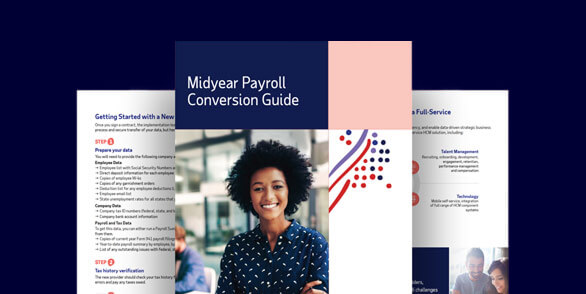
Payroll data migration checklist
The following checklist can help employers gather all the information necessary for payroll migration:
Employee data
- Employee list with Social Security numbers and addresses
- Direct deposit information for each employee
- Copies of all Form W-4, Employee Withholding Certificates
- Copies of any wage garnishment orders
- Deduction list for any benefits, e.g., health insurance, 401(k)
- Unemployment rates for all states where people are employed
Company data
- Federal
- Employer identification number (EIN)
- State and local tax ID numbers
- Company bank account information
Payroll and tax data
- Copies of the most recent Form 941, Employer’s Quarterly Tax Return
- Year-to-date payroll summary by employee, by quarter
- Correspondence with government agencies regarding any outstanding issues
Note: Payroll and tax data can be obtained by running a payroll summary report from the previous provider’s system or requesting a copy from them.
Data migration steps for a payroll or HRIS change
Generally, there are five phases to data migration: analysis, configuration, validation, production and post-live processing. These steps apply whether a company is small with a fairly simple payroll system, large with a full-scale HCM solution, or somewhere in between.
Phase 1: Analysis
- Business needs are assessed.
- Key stakeholders are interviewed.
- Data conversion needs are evaluated.
- Taxes, banking and general ledgers are analyzed.
Phase 2: Configuration and data conversion
Data is securely converted and transferred from a variety of sources, including standalone files and other software solutions or payroll providers.
Phase 3: Validation
- Employee data, tax history, payroll reports and security protocols and reviewed.
- Core users receive training on the new solution.
- Workflows, such as new hires onboarding or time-off approvals, are confirmed.
- A test payroll is processed.
Phase 4: Production
- The new payroll solution goes live.
- The first payroll is processed with provider support.
- Self-service launches.
Phase 5: Post-live processing
- Implementation support transitions to a dedicated service team.
- Connections are made with benefits carriers.
- Training on any additional functionality is provided.
Implementation and adoption: Making the switch successful
The long-term success of a new payroll or HRIS depends greatly on implementation and adoption. If these two tasks are not done well, IT may be inundated with questions and troubleshooting requests from people using the technology.
Implementation best practices
- Assess the vendor’s implementation plan, including any change management strategies and communication tactics.
- Evaluate the level of support that will be provided during implementation and how much involvement from internal IT professionals may be necessary.
- Inquire about available training options, such as on-site or virtual sessions, user manuals, and online resources.
Adoption best practices
- Engage stakeholders from the beginning of the migration so they are adequately prepared for the final product.
- Rely on the provider’s experience for adoption tactics that are specific to the business’s environment, industry or strategic objectives.
- Leverage technology, like artificial intelligence (AI), to deliver unique experiences that make adoption more intuitive.
Common migration pitfalls
Data migration becomes more difficult when companies are juggling an ecosystem of disparate HR technologies. Pre-built integrations and solutions for the most common use cases can usually overcome this problem. However, pitfalls may still arise due to a lack of data exchange options, budget, cross-department coordination, stakeholder coordination, technical resources or security.
Unavailable data exchange options
Systems vary in their ability to exchange data. Incompatible formats or a limited availability of application programming interfaces (APIs) may require fallback migration methods, like automated or manual file transfers.
Budgetary constraints
Migration requires some financial investment. Without adequate funding, the scope and timeline of an integration project can be negatively impacted.
Poor coordination between departments
A collaborative effort from HR, IT and finance teams is necessary for effective data migration. Delays, errors and inefficiencies often result if they cannot agree on goals, timelines or resources.
Stakeholder misalignment
System providers, middleware vendors and third-party integrators may all have a stake in payroll or HRIS integration. Aligning their different schedules and processes is essential to a unified migration strategy.
Inadequate technical resources
Depending on the project, skilled developers, system architects and IT support personnel may be required for both the initial implementation and ongoing maintenance of a new HRIS. Not every business has these resources in-house, which often necessitates professional service integration.
Security
Data integration must follow strict security protocols and industry regulations. Payroll and HRIS providers should be capable of meeting these requirements while also helping organizations maintain accessibility.
How ADP supports HRIS migration and ongoing HR operations
Businesses that switch to ADP Workforce Now® benefit from ADP Professional Services, a highly tailored supplemental program designed to help them get the most out of their new solution. It encompasses the following:
- ADP Advantage Program – Focuses on adoption, engagement and optimal utilization through strategic planning, training and communication.
- ADP history conversion services – Helps preserve at least seven years or more of payroll, employment and Affordable Care Act (ACA) history when organizations migrate to ADP Workforce Now.
- Design and planning – Helps ensure processes, people and technology are aligned with business goals to streamline operations and increase productivity.
- Post-implementation services – Shares best-practice recommendations with internal teams to ensure the system continues to deliver value to the organization over time.
Bottom line
ADP offers a range of payroll and HCM solutions that may suit businesses evaluating their options. For a seamless transition, clients should secure buy-in from stakeholders in advance, supply ADP with all required data on time and designate a project team to assist with implementation.
Frequently asked questions about migrating to ADP
How long does migration typically take?
The length of time needed to migrate to a new payroll provider depends on the breadth of services required and how quickly all the necessary data can be supplied. Some small businesses can be operational within a few days or weeks, while larger organizations may transition over a more extended period.
What data should be migrated when switching HR systems?
The data required for a timely and error-free transition includes the following:
- Job information – Job titles, worker classifications, exempt statuses, compensation, hire dates, work locations, tax withholding information and wage garnishments
- Personal information – Names, addresses, dates of birth, Social Security numbers, marital statuses and withholding certificates
- Business information – Federal, state and local tax ID numbers, plus year-to-date and quarter-to-date tax totals
- Payroll information – Pay frequency, workweek beginning and end, and next payday
- Beyond payroll – Benefits summary plan descriptions, performance appraisals and employment applications
Should you run parallel payroll during a migration?
Yes, the new payroll provider should run a parallel payroll along with the old provider to ensure everything is processing correctly. This task occurs after data migration is completed but before the first live payroll.
How do you map custom fields and workflows to a new HRIS?
Data field mapping establishes relationships between data fields (e.g., name, address, job title) across different systems, ensuring an accurate transfer of information. It may be accompanied by data translation, which converts data from one format to another, often for compatibility or usability reasons. APIs are commonly used to facilitate both processes.
What change management steps help drive adoption after switching HR platforms?
- Designate an executive sponsor or group of people to champion the change in platforms.
- Use effective communication tactics to notify employees about the upcoming transition.
- Provider training so employees can become proficient in the new solution.
HCM partners may be able to provide additional best practices for adoption based on their experiences with other businesses in similar industries.
Will I lose historical data during a migration?
Payroll and HCM providers typically build checks and balances into their migration processes to maintain data integrity. However, some responsibilities lie with employers. They should update any missing or incorrect data prior to the migration and ensure that the payroll provider has access to all the necessary information.
Can I keep using Lattice for performance management?
Lattice remains a talent and performance management solution, so existing customers should be able to continue using it for that purpose.
Important Notice: This article is intended to be used as a starting point for customers evaluating their HR technology options. ADP has not independently verified Lattice’s product plans; customers should contact Lattice directly for information about Lattice products. This article is provided with the understanding that ADP is not rendering legal or tax advice or other professional services.

Want more exclusive business insights like this delivered to your inbox?Subscribe now