Table of Contents
Employees may have multiple pay rates for a variety of reasons. They may perform one task at a certain rate while filling a different role at another rate. You may also have employees that are eligible for overtime pay, so you need to pay them “time and a half” based on Fair Labor Standards Act (FLSA) requirements1.
ADP’s payroll platform makes it easy to assign different pay rates for the same employee, automatically displaying all existing rates associated with each person, from hourly and salaried workers to contractors.
Why does an employee get paid two different rates?
An hourly employee who performs more than one job for the same employer can have two different pay rates, provided each rate is at least the applicable minimum wage.
For example, a restaurant worker may make $13/hour when working as a hostess, but $3/hour when working as a server and receiving tips. In such a scenario, up to a certain amount of the server’s tips can be applied toward meeting the minimum wage (known as the "tip credit"). If the employee’s cash wages and tips don’t equal or exceed the applicable minimum wage, the employer must make up the difference. Keep in mind some states expressly prohibit employers from taking a tip credit.
Another reason that an employee may receive two different wages is when they work overtime. If so, under federal law, the employee would be entitled to receive 1.5x their regular rate for any hours worked over 40 in a workweek. Some states require overtime in additional circumstances and at different rates.
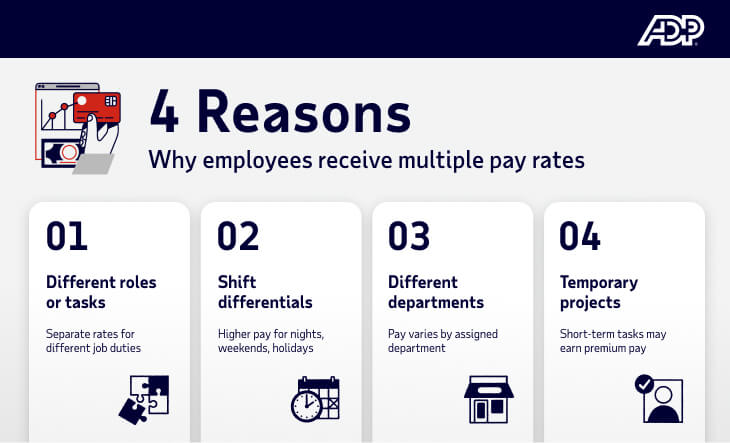
Here are the four most common ways an employee can get paid different rates:
- Different roles or tasks – The employee performs more than one job with distinct responsibilities, requiring separate pay rates.
- Shift differentials – Depending on the industry, night shift, weekend and holiday pay tends to be higher.
- Different departments – Some pay rates vary depending on which department an employee works in, and the same employee may rotate between departments.
- Temporary assignments and projects – There may be short-term work that’s time-sensitive or more complex and warrants a higher pay rate.
Managing multiple pay rates for different job duties
Wearing different hats on the job is commonplace, especially in certain industries such as healthcare, education, construction, retail and hospitality. To ensure fairness to employees while also meeting compliance requirements pertaining to wages and overtime, employers must efficiently manage multiple pay rate possibilities.
Consider the following multiple pay rate examples:
- Warehouse worker – This person may have a primary role handling inventory at $16/hour, but when the forklift driver is out, the warehouse worker is called to do forklift duty at $20/hour.
- School aide – This classroom assistant may make $15/hour as an aide but gets bumped to $18/hour when substitute teaching.
- Retail employee – A person who works the sales floor at one pay rate may make more when they stay for overnight inventory restocking.
All of these examples are lawful and legitimate ways employees might need to be paid two different pay rates, as long as each rate is at least the applicable minimum wage. The key is ensuring multiple pay rates are well documented, tracked, and easy to report on.
Applying multiple pay rates for hazard pay situations
Another great example of an employee having two different pay rates is hazard pay. Think: working in high-risk conditions that may affect a person’s health or safety. Hazard pay may be offered to a utility worker, for example, who’s tasked with repairing live power lines after a storm. A manufacturing employee who handles toxic material or operates in extreme conditions may receive hazard pay, as may healthcare workers during an infectious disease outbreak (e.g., COVID-19 frontline roles).
Explore ADP makes it easy to manage different pay rates for the same employee
Using multiple pay rates for shift differentials
When workers are required to work weekends, holidays or less desirable hours, it’s common to pay them a bit more for the inconvenience as well as the fatigue and potentially heavier workload during off-hours. Imagine a call center agent who earns a base rate of $18/hour but gets an extra $2/hour when working weekends. Or a grocery store worker who gets a 10% increase for working the night shift from 11 pm to 7 am.
Having a system that accommodates different pay rates for the same employee makes payroll a whole lot easier.
Handling multiple roles and pay rates for one employee
When the same employee performs two completely separate jobs at the same company, multiple pay rates may be applicable. In addition to the previous examples, consider a person who works in hospitality. On weekdays, they may be a front desk clerk at a hotel while on weekends they step into a banquet server role, receiving a different pay rate. Perhaps there’s a city employee who earns one rate working in parks and recreation but during the summer months receives different pay as a youth sports referee.
Get the payroll software that actually makes payroll easy
Find the option that works best for your business.
How payroll software simplifies the process
For employers, multiple pay rates add another level of complexity to the payroll process — particularly once overtime becomes a factor.
So, how can you pay an employee two different hourly rates?
Easy! Using ADP’s payroll software, just select from the list of existing pay rates that have already been set up for that employee or contractor, or use the “Enter Different Rate” option to add a new one. This flexible approach makes it easy to manage multiple pay rates while giving you full visibility into your payroll ecosystem.
Keep in mind, if you’re running payroll manually, it’s important to keep track of every employee’s pay rate and number of hours worked (or paid) at each rate, and calculate the correct pay rates for the correct tasks performed.
Tracking hours across multiple pay rates
Regardless of where your employees clock in (an app, a kiosk, a timecard, etc.), your payroll system should be able to readily track hours across different locations, shifts and departments. When you use a unified payroll platform for managing multiple pay rates, all systems talk to each other, helping minimize manual work, errors and headaches.
How to calculate overtime with multiple pay rates
To accurately calculate overtime pay, you must first determine the employee's regular rate of pay. An employee's regular rate includes their hourly rate as well as the value of nondiscretionary bonuses, shift differentials, and certain other forms of compensation.
When there are two or more rates of pay, the regular rate of pay for that workweek is the weighted average under federal law. However, federal law also allows employers to use the regular rate in effect when the overtime work is performed, as long as the employee agrees to this method in advance of performing the work and certain other conditions are met. These agreements should be in writing. Some states have different rules.
Keeping up with individual employees’ overtime pay can be overwhelming unless you’re using payroll software that can automatically calculate time-and-a-half based on an employee’s regular rate of pay. With built-in automations like this, your payroll software can help you stay compliant with wage laws while ensuring your employees are paid optimally and accurately.
It’s important to note that not all payroll service providers can accommodate employees with multiple pay rates. Be sure to choose a payroll system that's compatible with multiple pay rates for individual workers.

Find the option that's right for your business
However you need to pay your employees, we’ve got a solution for you.

Want more exclusive business insights like this delivered to your inbox?Subscribe now
1. https://www.dol.gov/agencies/whd/fact-sheets/56a-regular-rate