insight
Compliance requirements when you expand to new states (A simple guide for growing small businesses)
While growth is the goal of most small businesses, expansion into new states can bring HR compliance requirements that many businesses may not be prepared for or even aware of. A number of compliance requirements accompany expanding into new states, with many of them shifting right when a business hires in or operates across a new state line.
Here, you’ll learn about common HR compliance requirements, what they mean to small businesses and some of the ways that a PEO (professional employer organization) like ADP TotalSource can support your expansion by managing employment-related compliance, allowing you to focus on your core business strategy and entity registrations. Scroll down to read more about:
- Core registrations and payroll tax accounts
- Wage and hour changes to watch
- How pay transparency and job-posting laws affect your recruiting
- What PFML (paid family and medical leave) and paid sick leave programs mean for policies and payroll
- How workers’ compensation and safety requirements change
- Required notices and recordkeeping
- What changes (and what doesn’t) when you work with a PEO
Table of Contents
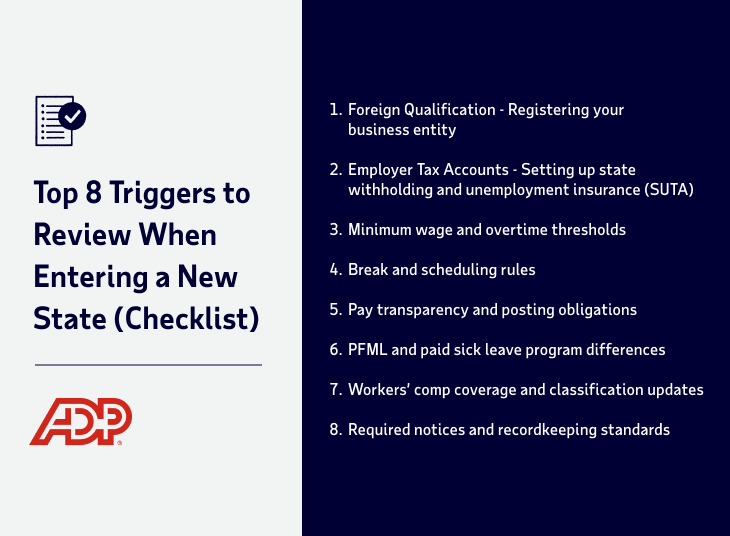
Business registrations vs payroll tax accounts
When expanding, you face two distinct types of registration, registering your business entity and registering as an employer. It is critical to understand the difference, as all outsourcing partners only handle the latter.
Business Entity Registration (Foreign Qualification)
Before you can hire, you need to register your company with the new state’s Secretary of State. This is often called Foreign Qualification. This ensures you have the legal right to do business there.
Who handles this: You do, often with your legal counsel or a registered agent.
Employer Tax Registrations
Once your entity is registered, you must set up the accounts to pay your employees compliantly. This includes:
- Obtaining a state withholding tax account
- Opening a state unemployment insurance (SUTA) account
- Completing new-hire reporting
Who handles this: If you use a PEO, they often assist with the registration and administration of these payroll tax accounts on your behalf.
Now that we have a real expert on our team, we can keep up with state-specific requirements.
Jeremy Copple,Senior HR Manager, Trojan Storage
See how Trojan Storage streamlined multi-state complianceWage & hour rules
Like many laws, wage and hour laws can shift dramatically from one state to another. As you expand to new states, ensure you are completely up to date with all the latest wage and hour laws. Things to keep in mind are:
- While there is a federal minimum wage, states and localities can still enforce their own minimum wages, and may vary greatly from state to state
- Exempt and non-exempt workers are entitled to certain protections under the Fair Labor Standards Act (FLSA), so correct employee classification is critical to avoid noncompliance
- Overtime thresholds vary significantly between states. While federal law requires overtime after 40 hours/week, states like California require daily overtime for hours worked beyond 8 in a single day. A number of states mandate things like paid rest breaks or meal breaks, all with specific timing or duration rules.
- Occasionally, recordkeeping requirements may differ as well, with factors like time records, pay statements and break documentation all demanding specific formats
Wage & hour rules takeaway:
When your business begins operating in a new state, make sure to evaluate local wage and hour regulations, including exempt and non-exempt status, scheduling rules, breaks, overtime calculations and recordkeeping requirements. Taking care to ensure that your scheduling practices align with all respective state-specific requirements reduces compliance risk(s) and makes audits and employee record requests significantly easier to manage.
Pay transparency & job posting rules
Pay transparency laws have greatly evolved over the past several years, and now vary significantly between states. The pay transparency information you’re required to include in a job posting, such listing things like salary range or benefits, is entirely dependent upon where the job is located or where prospective employees could work.
A growing number of states and municipalities now legally require businesses to disclose compensation ranges in job postings. Today, some of the most common requirements for pay transparency and job posting rules are:
- Disclosing salary and/or hourly ranges to the public
- Providing ranges to current employees upon request
- Including a summary of general benefits offerings in postings
- Adding all required disclaimers, such as an EEO notice
Pay transparency & job posting rules takeaway:
Create a simple, centralized process for setting and approving pay ranges before new postings go live. Even if hiring infrequently, a single remote job posting can trigger compliance if candidates in covered jurisdictions can apply.

Learn more about how our PEO can support your plans for expansion
Get a Compliance Risk AssessmentPFML & paid sick leave
Paid family and medical leave (PFML) and paid sick leave may sound similar, but they’re very different rules that kick in as soon as you hire in certain states. PFML covers longer-term life events while paid sick leave applies to everyday illnesses and appointments. Knowing this crucial difference helps small businesses stay compliant and avoid surprises.
Paid family & medical leave (PFML)
Several states operate PFML programs that are funded through employee payroll contributions, employer contributions or a combination of both. Each state’s program has its own set of rules governing eligibility requirements, waiting periods, contribution rates, and employer administrative responsibilities.
Paid sick leave
Paid sick leave laws establish guidelines employers must follow to ensure workers have access to adequate time off for health-related needs. These laws typically define minimum accrual rates, and may also include carryover rules that determine how much unused leave employees can roll into the next year, as well as annual usage limits that limit how much sick time can be taken within a given period. In addition, many paid sick leave laws set specific notice requirements, dictating how and when employees must inform their employer before using sick leave.
PFML & paid sick leave takeaway:
Considering the variability in PFML and paid sick leave laws, employers with a multistate presence should work to align their handbook and payroll processes with the most protective state rule in effect. This approach helps to reduce legal risk, simplify administration across states or jurisdictions and promotes consistent treatment of employees across the organization, wherever they live and/or work.
Workers’ comp & safety
Workers’ compensation is required in nearly every state, but exact coverage requirements, classification rules and posting requirements differ from state to state. When doing business in a new state, take care to consider:
- Whether your existing policy extends coverage (“all states endorsements”)
- Whether a new standalone state policy is required
- Classification updates for new roles
- Certificate of insurance needs
- State-specific safety or training requirements in the new state(s)
- Implementing a workplace safety program at the new location
Workers’ comp & safety takeaway:
As you add more locations, your workers’ compensation and safety responsibilities expand drastically. While audit readiness and precise job classifications are important, the more pressing priority is establishing a safe, compliant work environment across all states. Businesses must meet state-specific safety mandates, secure appropriate workers’ comp insurance and coverage limits, and ensure HR practices such as overtime rules, breaks, paid leave and labor law postings, are all fully aligned with local regulations. A proactive approach to workers’ comp and safety reduces risk, promotes employee well-being and supports sustainable growth.
Required notices & recordkeeping
State and local posting rules shift the moment you begin employing workers in a new jurisdiction. Some of the most common required notices to be ready for are:
- State labor law posters
- Wage notices
- Workers’ comp notices
- Unemployment insurance postings
- Anti-discrimination and rights notices
For recordkeeping, be sure to consider:
- Retention timelines
- Paystub content requirements
- Whether electronic delivery is acceptable for your industry or state
Required notices & recordkeeping takeaway:
Employers must be aware of all state and local posting requirements and recordkeeping rules wherever they do business. Not being prepared in these matters can cause noncompliance and may result in fines and penalties.
What a PEO Changes (and what you still own)
A Professional Employer Organization (PEO) helps small and midsized businesses manage multistate HR compliance more confidently by providing ongoing HR expertise and risk-mitigation support.
| How a PEO Supports You | What You’ll Still Handle |
|---|---|
| Employment Tax Administration — Assisting with setting up a managing SUTA and withholding accounts | Entity Registration — Filing Foreign Qualification with the Secretary of State |
| Proactively monitoring regulatory changes across states | Employment Handbook policies (with PEO guidance) |
| Process client’s payroll | Accurate reporting of employee hours worked and compensation – and approval of billing invoice based on information submitted to the PEO |
| Maintains workers’ comp insurance, administration, claims management, certificate of insurance, and a risk & safety program | Day-to-day employee management |
| Provides access to HR expertise for employment handbook policy updates and day-to-day questions | Creating and instituting company culture |
What a PEO changes takeaway:
For small teams, a PEO can significantly reduce time spent on payroll tax registrations, labor posters and assistance with employment policies, especially during times of expansion. But beyond saving time and helping build HR compliance-confidence, a PEO like ADP TotalSource helps to remove some of the guesswork that comes with running a business. With the knowledge of each state’s HR requirements and processes, the PEO can guide small businesses at every step, helping teams move and grow quickly while meeting compliance obligations.

From compliance to talent and beyond, our PEO can help you grow
Learn MoreFAQs about PEOs and expanding businesses
What registrations do we need to hire in a new state?
You typically need two types:
- Business Entity Registration (Foreign Qualification) with the Secretary of State, which you handle.
- Employer Tax Accounts (withholding/SUTA), which the PEO can assist with.
Do overtime thresholds and meal/rest rules change by state?
Yes. Many states exceed federal requirements, while some mandate specific break schedules. Be sure to know the most up-to-date requirements wherever you plan to expand.
Which states require pay transparency in job postings?
A growing number of states and municipalities. Requirements vary by role location, remote eligibility and posting visibility.
How do PFML and paid sick leave vary?
State programs differ in contribution rates, eligibility, accruals and notice rules. Policies should be aligned with the most protective standard across operating states.
Do we need a new workers’ comp policy when we add a state?
It depends on the state. Most states recognize "all-states endorsements," but monopolistic states (Ohio, North Dakota, Washington, Wyoming) require you to purchase a separate policy directly from the state fund.
What compliance tasks does a PEO handle vs what we keep?
A PEO typically manages employment tax accounts, payroll processing, workers’ comp administration and HR regulatory monitoring. Employers manage policies, leadership decisions and employee supervision.
Want more exclusive business insights like this delivered to your inbox?Subscribe now
All information in this guide is based on publicly available regulatory summaries, generally accepted HR compliance practices, and standard employer obligations across U.S. states. The information herein shall not be relied upon as legal or tax advice. No state-specific legal interpretations are included, and businesses should review local requirements or consult compliance professionals for jurisdiction-specific guidance.