insight
What does a PEO cost? How pricing works and how to compare total employment cost
Last updated: July 14, 2026
PEO providers commonly structure pricing in one of two ways: as a percentage of payroll or as a set dollar amount per employee. Administrative fees may range from 2% to 12% of total payroll or about $40 to $160 per employee per month1, depending on the PEO provider, services included, workforce size, employee locations, and workforce risk factors such as industry, job roles, and any applicable claims history.
Those figures answer the question most businesses start with: what does a PEO cost? The more useful question is: what am I paying for employment today, and how does a fully scoped PEO proposal compare? The administrative fee is only one component of total cost — benefits, workers’ compensation, and the responsibilities a PEO assumes often matter more.
This page explains how PEO pricing works, what drives cost, and how to compare it to what you’re paying today.
Key takeaways about PEO pricing
- PEO administrative fees are structured as a percentage of payroll (typically 2% to 12%) or as a per-employee fee (about $40 to $160 per employee per month).
- Quotes are risk-adjusted based on workforce size and demographics, industry, employee locations, payroll structure, and compliance complexity.
- The administrative fee is only one component of total cost. Benefits, workers’ compensation, and additional services can vary more by provider than the administrative fee itself.
- The most meaningful comparison is your fully loaded employment cost today versus a fully scoped PEO proposal.
How PEO pricing works
Most PEO pricing is structured in one of two ways:
PEO pricing models at a glance
| Percentage of payroll | Per-employee fee |
|---|---|
|
The administrative or service fee is calculated as a percentage of total payroll. This model can align with the way many employment-related costs already work, including payroll taxes and workers’ compensation. |
The administrative or service fee is set as a dollar amount per employee, often monthly or per payroll cycle. |
Neither model is automatically better. What matters is what the fee includes, what is billed separately, and how the structure fits your workforce and growth plans.
PEO pricing is risk-adjusted because a PEO becomes a co-employer, contractually assuming administrative employer responsibilities — payroll and employment tax withholding and remittance, workers’ compensation coverage and claims administration, and benefits offerings. That responsibility has to be priced to the actual workforce it covers, which is why quotes reflect workforce size, industry, locations, and risk factors rather than a universal rate.
Some PEOs promote flat administrative fees, while others use risk-adjusted pricing models. Neither approach is inherently more transparent. What matters is what the fee includes, what is billed separately, and whether the model can support the business you’re building, not just the one you have today.
How PEO pricing differs from software pricing
Software-as-a-service (SaaS) pricing is based on access to software — logins, features, and usage tiers. PEO pricing is built around people, payroll, insurance, compliance, and shared employment risk.
Benefits illustrate the difference. Health and ancillary benefits depend on plan design, employer contributions, employee elections, carrier pricing, and where employees are located. Those variables cannot be responsibly reduced to a universal monthly software-style price.
What factors influence PEO pricing?
PEO providers adjust pricing to reflect actual employment-related costs and risks by weighing the following factors:
- Workforce size and demographics
- Payroll and wage structure
- Industry risk profile
- Geographic footprint and HR compliance complexity
- Workers’ compensation
- Scope of HR advisory services
Each factor directly impacts cost. A simple estimate can start with major categories like service fees, benefits, and workers’ compensation, but a responsible quote reflects your workforce, locations, wages, job classifications, and industry risk exposure.
What’s included in a PEO investment?
A PEO is a multi-layered solution. The exact scope matters because two PEO proposals can look similar on the surface but include very different levels of service, protection, and risk support. In practical terms, a PEO relationship may include:
- Payroll processing and payroll tax withholding and remittance
- Workers’ compensation coverage and claims management
- HR compliance guidance
- Employment practices liability insurance (EPLI) coverage
- Benefits access and benefits administration support
- Unemployment claims support
- Talent management support
- Access to HR technology
The PEO value stack
Together, these services create the value behind the PEO relationship. PEO pricing reflects four core areas:
Vendor consolidation
A PEO brings payroll, benefits, HR compliance, HR technology, and workers’ compensation into a single integrated relationship, replacing multiple vendors, systems, and internal overhead.
- Reduced administrative overhead
- Fewer vendor contracts and systems
- Lower coordination costs
Expertise, guidance and protection
Access to specialized HR, payroll, employment tax, benefits, HR compliance, and employment-related expertise that supports day-to-day decisions as well as high-risk situations.
- Faster, more confident decisions on complex employment matters
- Reduced exposure to HR compliance and employment-related risk
- Greater consistency in how employment issues are handled across the organization
Workers’ compensation and risk management
Workers’ compensation is integrated into the PEO relationship, with coordinated claims support and workplace safety guidance, rather than managed as a standalone policy.
- More stable and predictable workers’ compensation costs through PEO scale
- More structured and consistent claims handling with coordinated support
- Lower administrative effort managing policies and renewals
Access to better benefits
A PEO can help employers access benefits options and pricing that may otherwise be harder to secure on their own.
- Competitive pricing
- Expanded plan options
- Access to varied carriers
Fixed costs vs. variable PEO costs
| Fixed costs | PEO service fee |
|---|---|
These pay your employees’ salaries, cover the company’s contributions to benefits and retirement savings, and fund payroll taxes. These costs are dictated by employee agreements, benefit plan choices, and where you operate, not by the PEO. |
Using ADP TotalSource as the example, the PEO service fee covers the ADP technology, expertise, and protection that sit on top of those fixed costs. It includes integrated HR, payroll, and benefits technology; dedicated HR expert support, HR compliance, payroll and employment tax withholding and remittance, workplace risk and safety benefits, retirement savings, benefits administration, workers’ compensation insurance, EPL insurance coverage (along with a contractual legal defense benefit), employee support services and workforce management capabilities. |
Evaluating PEO costs
Before comparing pricing, it helps to understand what you’re actually looking at. A PEO invoice is not always a single line item. Depending on the provider, total cost may include:
- A service or administrative fee
- Workers’ compensation
- Payroll taxes
- Employee benefits
Benefits are often billed separately because they depend on plan design, contribution levels, and employee elections. Workers’ compensation may be bundled into the service or administrative fee or shown as a separate cost depending on the provider.
Why the admin fee isn’t the number that matters
Many businesses compare PEOs based on administrative fees alone, but this doesn’t reflect the total cost. The admin fee is only one component; benefits, workers’ compensation, and additional charges can vary significantly by provider and often have a greater impact than the admin fee itself.
What is included in that fee also varies. For example, workers’ compensation is sometimes shown as a separate line item rather than included in the PEO’s service or admin fee. A provider may advertise a lower administrative fee, but the cost of workers’ compensation is billed separately, making the admin fee an incomplete indicator of total cost. Some PEOs add a risk fee on top of the admin fee and workers’ compensation cost.
With ADP TotalSource, workers’ compensation is managed and included as part of the service fee, so it’s accounted for upfront rather than added later as a separate charge.
When evaluating providers, look at the fully loaded cost rather than the administrative fee alone:
- Administrative/service fee
- Benefits
- Workers’ compensation (if separate)
- Other employment costs (if applicable, such as additional HR-related services)
When you compare the fully loaded PEO cost to what you’re paying today, including any broker fees, workers’ comp premiums, compliance tools, HR systems and internal time, the PEO often matches or lowers your total spend, while expanding coverage.
Where cost savings actually come from
A PEO may also create savings by reducing the number of separate vendors, lowering administrative employment burdens, improving workers’ compensation support, strengthening HR compliance practices, and helping employers access benefits they may not be able to secure as easily on their own. These savings are not always visible in the administrative fee. They often show up in reduced complexity, fewer coverage gaps, more predictable costs, improved employment-related claim outcomes, and time returned to the business.
According to the National Association of Professional Employer Organizations (NAPEO), companies using a PEO see an average annual return on investment of 27.2% from cost savings alone.
Understanding where those savings come from also explains why pricing isn’t instant.
What is PEO underwriting?
Underwriting is how a PEO aligns pricing to actual employment risk. Because the PEO contractually assumes administrative employer responsibilities including payroll administration, employment tax withholding and remittance, benefits offerings, and workers’ compensation coverage and claims administration, it evaluates employee wages, job classifications, locations, benefits elections, and workplace risk exposure before pricing that responsibility.
The process ensures coverage is structured correctly and that costs don’t surface later as adjustments, exclusions, or unexpected add-on fees. A quote built without complete workforce information may leave some costs or assumptions unresolved, potentially resulting in later adjustments or retained employer exposure.
Are there hidden fees with a PEO?
What buyers often describe as “hidden fees” usually comes down to differences in how providers structure pricing. PEOs don’t itemize or price services uniformly: one provider may include workers’ compensation, EPLI, or compliance services within a single service fee, while another shows a lower administrative fee and bills those items separately. Neither invoice is necessarily missing anything, but the two aren’t comparable at face value.
To avoid surprises, ask every provider for an all-in quote and an unbundled view of the invoice: the administrative fee, workers’ compensation, benefits, and any additional services shown separately, along with the assumptions used to build the quote. A complete, underwritten proposal ties every cost to a service or coverage you’re purchasing.
Published PEO pricing vs. fully loaded cost
Some PEO providers publish starting prices or flat administrative fees, which can make early research feel simpler. However, a published administrative fee does not always represent the full cost of a PEO relationship. Depending on the provider, these key components may be included, optional, or billed separately:
- Benefits
- Workers’ compensation
- Employment practices liability insurance (EPLI)
- HR compliance and employment-related risk support
- Time tracking or workforce tools
- Implementation and HR advisory services
This does not mean published pricing is inaccurate. It means the price reflects a specific set of assumptions that may not match your workforce, locations, or risk profile. The more meaningful comparison is the fully loaded cost of the relationship and what that cost includes. That is also why most PEO pricing is built through underwriting and structured as risk-adjusted pricing, rather than a universal flat rate.
How to compare PEO proposals apples to apples
When you’re evaluating PEO options, the biggest mistake is comparing pricing without understanding what’s behind it. Use these questions to make sure you’re comparing the same thing:
- What is included in the service or administrative fee?
- Is workers’ compensation included, or billed separately?
- Are employment practices liability insurance or risk-related costs included?
- How are benefits priced and billed?
- What services are included as part of the core PEO services?
- What optional services does the PEO offer that can be added as needed?
- What assumptions were used to build the quote?
- What happens if headcount, payroll, locations, or job classifications change?
- Is the provider an IRS-certified PEO or ESAC-accredited?*
- What does implementation include?
- What will your actual invoice look like?
*Certification and accreditation can help signal that a provider meets recognized standards for financial responsibility, PEO regulatory compliance, and business practices.
Two proposals can look similar on the surface but represent very different levels of service, coverage, and risk support. These questions help you understand what you’re actually buying.
What types of companies benefit from a PEO?
Different businesses use a PEO for different reasons, some need help managing growth, others need support across states, industries, benefits, HR compliance, or day-to-day workforce operations. A PEO like ADP TotalSource is designed for single-state employers building a foundation, multi-state teams navigating regulation, companies in regulated industries, and rapid-growth businesses. Even if your needs are simpler today, you’re not overpaying for complexity you don’t have, and you’re covered as your business evolves.
Here are a few examples of how companies are using ADP TotalSource:
- Avalon Park: A multistate business using ADP TotalSource to support a workforce operating across many states.
- Sparkle: A smaller U.S.-based team with international headquarters, using ADP TotalSource to support its U.S. workforce.
- Work Health Solutions: A business in a highly regulated state using ADP TotalSource to support workforce operations in a complex employment environment.
ADP’s PEO: Your business’s competitive edge
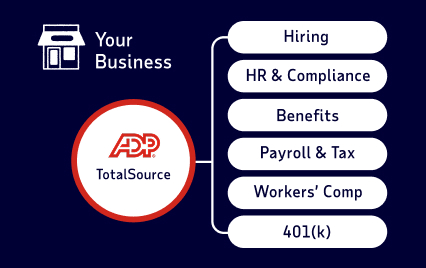
ADP TotalSource®, our PEO, offers a cost-effective HR solution that handles benefits, payroll, tax support, workers' compensation, and hiring, so you can get back to business.
What to expect when getting a PEO quote
Below are answers to the most common questions we hear about the evaluation process.
What is the process to get a quote from a PEO?
The process includes an initial consultation, employee-level data review, underwriting analysis, and a proposal outlining pricing and potential savings.
Why do PEOs require a quote for pricing?
Because a PEO becomes a co-employer, it contractually assumes administrative employer responsibilities including payroll taxes, workers’ compensation coverage, benefits administration. Pricing that responsibility requires knowing the workforce it covers: wages, job classifications, locations, and risk exposure vary too much across businesses for a one-size-fits-all rate. The quote process is how that responsibility gets priced accurately.
How quickly can a business expect a return on investment from a PEO?
In a recent ADP TotalSource client survey, 70% of clients experienced measurable value within six months. Separately, NAPEO has reported an average annual ROI of 27.2% from cost savings alone for companies using a PEO.
Why do some PEOs bill as a percentage of payroll?
Because it mirrors the way employers already pay for labor costs: FICA, Medicare, FUTA, SUI, and workers’ compensation. These are all calculated as a percentage of payroll. The PEO fee works the same way, because the services behind it scale the same way. It also simplifies the math. The PEO applies percentages against total payroll, rather than itemizing taxes, insurance, and a per-employee admin fee multiplied by headcount.
The bottom line on PEO pricing
When a business hesitates on PEO pricing, it’s usually comparing the quote to what it pays right now. That comparison often leaves out broker fees, compliance gaps, administrative time, and the employment risks that sit quietly until they don’t.
The question isn’t whether a PEO costs money. It’s whether what you’re doing now is actually cheaper… or just feels that way.
- The price for PEO services is calculated exactly for what your business needs. No more. No less.
- Costs are adjusted based on real employment and HR compliance factors, which vary by state, industry, and workforce.
- Flat-fee models are simpler to compare, but the fee is only one component of total cost — confirm what’s included before comparing.
If you’re still exploring, that’s okay. If you’re ready to see how this applies to your business, let’s talk

Want more exclusive business insights like this delivered to your inbox?Subscribe now