insight
Payroll database
Last updated: February 5, 2026
Payroll data never stops accumulating. Businesses collect and use this information to compensate employees correctly, comply with regulations and manage budgets. Yet, payroll data can support more than just basic operations. When integrated with HR systems, payroll databases help employers make strategic workforce decisions.
Payroll database key takeaways:
- Modern, electronic payroll databases help employers safeguard sensitive information, like employee salaries, tax ID numbers, worker classifications and more.
- Working with a payroll provider gives employers the ability to run reports, extract insights from payroll data and integrate it with information from other systems, e.g., time and attendance.
- Analyzing payroll data can help businesses manage costs, formulate retention strategies and identify workforce training needs.
- Multifactor authentication, adaptable software and resilience planning can help protect payroll databases.
Table of Contents
- What is payroll data?
- What is a payroll database?
- How to establish a payroll database
- How to leverage payroll data
- Benefits of payroll data integration
- Payroll database example
- How to choose the right payroll database design
- How do payroll databases support compliance?
- Best practices for the security of payroll data
- How to collect payroll data
Payroll data meaning: What is payroll data?
Payroll data encompasses any information related to paying employees and filing employment taxes. New data is created each pay cycle and must be saved for the lengths of time required by federal, state and local governments.
Payroll data examples
Payroll database fields may include the following information:
- Job information – Job titles, worker classifications, exempt statuses, compensation, hire dates, work locations, tax withholding information and wage garnishments
- Personal information – Employee names, home addresses, dates of birth, Social Security Numbers (SSNs) and marital statuses
- Business information – Federal, state and local tax ID numbers, plus year-to-date and quarter-to-date tax totals
- Payroll information – Payroll frequency, workweek beginning and end dates, and state and local pay requirements
What is a payroll database?
A payroll database helps businesses organize and safeguard all their requisite payroll records. Modern solutions are electronic or online and capable of aggregating information for each employee. Authorized accountants and payroll professionals can easily access these records and run reports. Many payroll services also offer self-service tools, so employees can view their Form W-4 withholding selections, pay statements and paid time off (PTO) balances.
How to establish a payroll database
The process of establishing a payroll database depends on each organization’s capabilities. Generally, there are three options – build from scratch, purchase standalone software or partner with a full-service payroll provider.
Building a payroll database from scratch
Do-it-yourself payroll recordkeeping requires internal information technology (IT) resources to create original systems and may necessitate hiring new talent to build and manage the database. There may also be ongoing costs for maintenance and upgrades. Organizations typically only choose this approach if they have unique data needs or proprietary technology that can’t easily integrate with off-the-shelf payroll software.
Purchasing standalone software
When buying payroll or HR analytics software, employers might use a third party to integrate their data streams. They then use their own resources to implement, run and manage the solution. This approach is ideal for organizations that already have analytics tools and teams producing reports for finance, sales or other business functions.
Partnering with a payroll service provider
Payroll providers go beyond both DIY and standalone software solutions. They can integrate analytics into core payroll workflows and deliver insights via dashboards and reports. As such, partnering with a payroll provider is the most turnkey option. It works best for organizations that don’t want to invest the time, money or resources in their own payroll database.
Explore Payroll and HCM data migration tips
How to leverage payroll data
To get the most from their payroll data, employers must first pinpoint where it originates and how it’s categorized. A well-equipped payroll solution can achieve that objective, helping analysts leverage greater insights in the following areas:
Wages and overtime
With this data stream, employers can identify the average employee wage by location. They can also spot high and low outliers, as well as the total overtime hours worked and their associated cost. Collecting and curating this data can help drive long-term business strategies, especially for larger organizations that operate in multiple states or countries.
Employee retention
Payroll data can be used to calculate the average length of time employees stay with an organization. A high-quality payroll solution may allow employers to compare this data across multiple job sites. They can then evaluate what's working at locations with high tenure rates and focus their retention efforts on those with lower rates.
Workforce training needs
Data from a payroll system, particularly one that integrates with talent or learning management software, can provide a big-picture view of training needs. Employers may be able to see which locations have enough trained staff, which need more and which could benefit from internal assistance, such as temporary experienced employees.
Growth patterns
Payroll data can underscore business growth trends and help identify potential problems. For instance, higher payroll costs often indicate business growth through increased working hours or focused hiring efforts. But when payroll spending is up and revenues are down, it may signal a disconnect.
Benefits of payroll data integration
Integrating payroll into larger data streams offers many advantages. For starters, it can help enhance the employee experience, improve operations and reduce costs.
Enhanced employee experience
Connecting payroll with training data and employee feedback can be used to create tailored education plans that improve workforce morale and efficiency.
Improved operations
Understanding employment trends across sites can help employers determine where to invest their resources most effectively. For example, if a location has many long-tenured employees, the company may need to prepare for a wave of retirements.
Reduced costs
If businesses aren't compliant with employment laws and regulations, they could face fines or penalties. Complete visibility into employee wages, overtime and working-hour data helps reduce the risk of costly noncompliance.
Payroll database sample: The information flow process
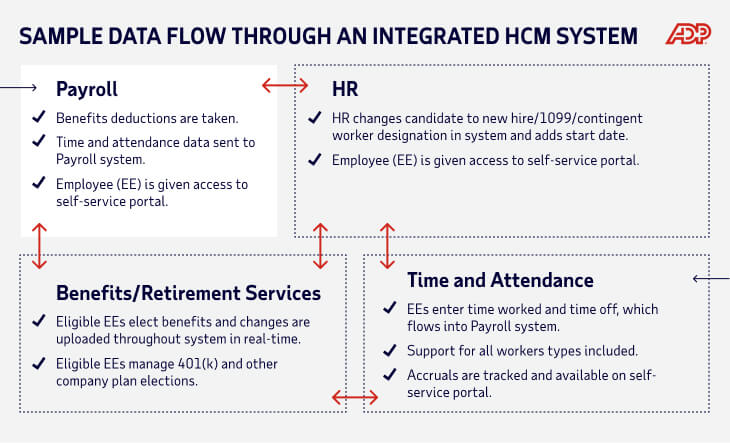
Here you can see how payroll and HR functions are integrated into a unified system that shares data, maintains compliance updates and allows for reporting and analytics across the entire platform:
How to choose the right payroll database design
When choosing a payroll partner to supply a database, employers should ask a series of questions evaluating the vendor’s capabilities, the types of insights they can provide, how the setup may impact IT, and whether the solution is future-proof.
Does the partner have the right priorities?
It’s important for software providers to have payroll and analytics as core competencies. Their solution should also continually work to minimize extra cost and complexity for the client. Finally, they should fully understand the company’s objectives and build them into the system.
What insights can the payroll partner provide?
Employers must first determine what they want to achieve with their payroll and HR data. They can then assess if a potential partner has the capabilities to deliver the desired insights without having to pay for unnecessary functionalities.
Can the payroll provider contextualize the data?
Some partners provide insights that show employers exactly what’s going on in their own companies. Others go further and deliver data in the context of benchmarks based on industry, job function, location, etc.
How will system setup affect IT resources?
Payroll implementation shouldn’t put undue strain on an employer’s internal technical resources. If data must be migrated from multiple legacy systems to the new solution, employers should look for a provider capable of supporting IT throughout the process.
Is the payroll solution future-proof?
It’s vital for a payroll provider to fit with the client organization’s medium- and long-term goals. Asking what capabilities a potential partner has in the pipeline is a good way to gauge their expertise and commitment to delivering in the future.
Enjoy easy, online payroll processing
ADP handles automated deductions, filing, and more.
How do payroll databases support compliance?
Federal and state government agencies require employees to save payroll data for specific lengths of time. For instance, the Fair Labor Standards Act (FLSA) mandates that employment records be kept for three years. The requisite information includes, but is not limited to:
- Total weekly hours worked
- The basis on which employees were paid (hourly, salary, piecework)
- Regular hourly pay rate
- Total daily or workweek straight time earnings
- Total overtime earnings per workweek
Knowing where and how to save this information can be challenging, but an electronic payroll database simplifies the process greatly. Most systems create profiles for each employee that aggregate all data required by the FLSA and other regulatory agencies.
Best practices for the security of payroll data
Payroll data is valuable to malicious actors, and businesses of all sizes may be at risk. To improve data security, employers may want to implement these measures:
- Training – Organizations should define what they expect from staff in their policies and procedures and train people appropriately.
- Back to basics – Basic security protocols (software patches, firewalls, access controls, etc.) can help protect businesses daily.
- Resilience planning – Employers should know where their data is stored and what to do or who to contact if an incident occurs that negatively impacts payroll.
- Automation – Automating payroll can help streamline labor-intensive and error-prone tasks, thereby giving payroll practitioners more time to identify potential payment outliers.
- Authentication – The benefits of multifactor authentication with single sign-on are two–fold: it reduces friction when people log in to payroll systems and reduces security breaches.
- Adaptation – Organizations need payroll systems capable of keeping pace with ever-evolving security threats.
How to collect payroll data
Automated payroll solutions are usually the best choice for collecting payroll data because they eliminate the need to manage multiple manual processes. In addition, many systems are capable of integrating payroll information with other data sources, like HR and finance. Cross-database integrations are particularly helpful for businesses operating in multiple states or countries because they facilitate both large- and small-scale analyses.
How to analyze payroll data
Payroll analysis involves identifying the root cause of trends and using that information to act accordingly. For example, consider a situation in which a business experiences an increase in retirees and overtime costs during the same period. Such data might indicate that less-experienced staff are struggling to bridge the knowledge gap. In response, the employer could create a training program that helps new hires transition into the roles vacated by the retirees.
Frequently asked questions about data analytics in payroll
What are the different types of payroll data?
Payroll data can be specific to the employees, the employer or the payroll cycle itself. Examples from each type include employee gross wages, taxes owed by the employer to government agencies and the beginning and end dates of a pay period.
Why is payroll data important?
Collecting and archiving payroll data is essential to complying with employment recordkeeping requirements at the federal and state levels. Employers generally must keep payroll records for at least three years according to the FLSA, but state regulations may be longer. Maintaining accurate payroll data also helps businesses adhere to budgets and ensure that employees are paid correctly.
What are the benefits of leveraging payroll data?
Acting on insights gathered from payroll can help employers improve the employee experience, make smarter workforce decisions and potentially save money. For example, if the data shows that overtime hours are higher than average, employers can investigate the reason and correct any underlying problems before expenses skyrocket or employee morale suffers.
How does payroll data strengthen global business decisions?
Global businesses need payroll data collection tools that can integrate information from multiple sources into a single repository. This unification allows them to compare data across different sites and make more informed workforce decisions – locally and internationally.
Why is a payroll database important for businesses?
The amount of information that employers must collect to run payroll is vast, and new data is generated every pay cycle. Tracking and organizing this much data can be challenging using spreadsheets or paper-based filing methods. An electronic or online payroll database, in contrast, simplifies the process by automating data collection and allowing employers to mine strategic insights via dashboards or reports.
How is data security enhanced by a payroll database?
Online payroll databases backed by a reputable provider typically have multifactor authentication to safeguard sensitive information. Such vendors may also regularly assess their networks and update their software to keep pace with evolving security threats.
Is a payroll database suitable for small businesses?
Companies of all sizes must comply with payroll recordkeeping requirements and protect their data from malicious actors. However, small businesses may be more susceptible to compliance violations and security threats due to a lack of resources. An electronic payroll database can help them meet expectations and potentially avoid costly losses.
What are the costs of a payroll database?
Payroll providers typically include payroll databases as part of their basic service offering. Costs vary depending on the client’s number of employees and how often they run payroll. Compare small business payroll packages available from ADP

Want more exclusive business insights like this delivered to your inbox?Subscribe now
This article is intended to be used as a starting point in analyzing database payroll and is not a comprehensive resource of requirements. It offers practical information concerning the subject matter and is provided with the understanding that ADP is not rendering legal or tax advice or other professional services.