insight
HR software for startups
Last updated: March 23, 2026
Effective payroll and HR management sometimes poses a challenge for startup businesses that lack the resources of larger, more established companies. Yet, new employers with limited funds can still succeed. There are realistic, affordable HR software solutions on the market that can help them hire and pay people while supporting compliance.
HR software for startups key takeaways:
- HR software is an integrated suite of payroll, benefits, and workforce management tools that can help startups improve productivity and compliance.
- Scalable HR software can adapt to a startup’s growth needs and help it overcome unexpected disruptions.
- Insights from HR software enable startups to make more informed decisions about their workforce.
- Evaluating HR software against criteria specific to startup businesses can help employers find the solution that’s right for them.
Table of Contents
What is HR software for startups?
HR software is technology that helps startups manage payroll, time and attendance, benefits administration, regulatory compliance and employee performance. Integrating these functions into a single solution gives new employers a comprehensive view of their workforce, enabling them to make data-driven decisions. Software can also help align HR with a startup’s goals and enhance employee engagement and productivity.
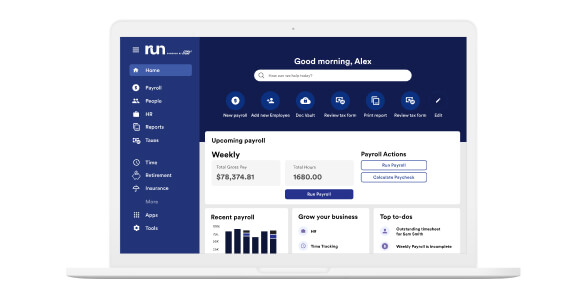
Get payroll, HR and so much more with ADP
ADP's comprehensive payroll solutions help you ensure accuracy, compliance, and efficiency – no matter your business size.
Features to look for in startup HR software
HR software offers various capabilities to accommodate size- and industry-specific business needs. Some of the features essential for startups include:
- Employee information management
- Payroll and benefits management
- Time and attendance tracking
- Talent management
- Workforce planning and analytics
- Compliance and risk management
Employee information management
At its core, HR software is the central repository for employee data, encompassing personal info, work history, skills and certifications. It should facilitate easy updates, secure access and data privacy. Startups that rely on different types of labor should also look for HR software that can accommodate full-time, part-time, temporary, contract and contingent workers.
Payroll and benefits management
Effective payroll and benefits management is crucial for employees to access their earned compensation. As such, HR software for startups should perform the following:
- Automate payroll calculations and deductions
- Support labor law compliance
- Generate pay statements
- Track wage and salary adjustments
- Enable flexible pay options
- Simplify benefit enrollment processes
- Verify benefit eligibility
Time and attendance tracking
Accurately tracking employee time and attendance with HR software supports productivity and compliance. The solution should include timekeeping features such as clock-in and clock-out, timesheets, and leave tracking. To further enhance workforce management, startups may want to look for software with overtime monitoring and employee-friendly scheduling options, such as shift swapping.
Talent management
Talent capabilities within HR software may include acquisition, onboarding, training and professional development, compensation management and succession planning. Ideally, the solution should align a startup’s talent strategy with its business goals and help increase employee engagement.
Workforce planning and analytics
HR software may deliver real-time reporting and on-demand access to workforce metrics. Some systems even offer benchmarks against peers and predictive analytics for forecasting labor needs. All together, these capabilities enable startups to make more informed, data-driven decisions.
Compliance and risk management
HR software must continually update to stay current with changing employment laws and regulations. Yet, technology is just one aspect of compliance for startups. Providers should also lend best-practice guidance on tax filing, wage garnishments, employee payment methods, health-care statutes and more.
Benefits of using HR software for startups
HR software can help startups take their businesses to the next level. They’ll be poised to meet the latest workforce trends and reap benefits, like increased profits, strategic growth, employee engagement and improved decision-making.
Profitability
HR software helps reduce expenses by automating labor-intensive and time-consuming administrative tasks. In turn, employers can focus more attention on activities that drive revenue.
Strategic growth
Reputable HR software should be capable of adapting to planned growth initiatives, like expansions to new locations, and unexpected disruptions, such as regulatory changes. Some providers may even offer a marketplace of turnkey solutions that startups can add to their technology stack as needs evolve.
Employee experience
Well-designed HR systems offer seamless, personalized experiences through mobile accessibility, self-service tools and customization options. Employee engagement, efficiency and satisfaction often improve as a result.
Data-driven decision-making
Startups can use the insights available in their HR software to identify successes and areas that need improvement. They can then make strategic decisions and adjustments backed by data to positively impact business operations.
How to evaluate HR software for startups
The following steps can help startup businesses find an HR software solution that effectively connects their people and processes:
- Identify business needs
Clearly outline the organization’s needs and priorities. This step will help startups stay focused and evaluate vendors based on how well they meet HR requirements. - Define success
Establish the criteria for determining whether HR software is effective and aligns with the startup’s goals. Helpful litmus tests include key performance indicators (KPIs), benchmark data, timeframes and desired outcomes. - Conduct thorough research
Gather information on different HR software providers, their products and their reputations in the market. Their strengths and weaknesses can be identified via industry reports and customer reviews or case studies from other startups. - Build a shortlist
Narrow the list of potential providers based on their reputation and alignment with requirements. - Evaluate product fit
Further evaluate the features, functionalities and customization options of each software solution on the short list. Also consider if the technology meets security standards and compliance needs. - Understand integrations
Assess the compatibility and connectivity of the HR software with the startup’s existing technology stack. It’s helpful to identify the specific data that must be shared and whether any application programming interfaces (APIs) are available to aid integration. - Request proposals
Send shortlisted providers detailed request for proposal (RFP) documents outlining requirements, expectations, evaluation criteria and timing. - Evaluate implementation and support services
Consider the vendor’s implementation methodology and timelines, and ensure they provide adequate support services during and after the process.
Frequently asked questions about HR software for startups
When should a startup get an HR system?
Ideally, startups should invest in payroll or HR software as soon as they’re ready to hire their first employee. Some businesses on tight budgets wait until they’ve grown large enough to purchase a solution, but this approach poses compliance risks.
What is an HRIS and why does my startup need one?
HRIS, or human resources information system, is software that integrates payroll, HR, benefits and compliance into a single platform. Startup businesses often need this technology because their legacy HR management processes struggle as operations expand. An HRIS, in contrast, eases administrative and regulatory burdens and provides data-driven insights that simplify decision-making.
Does ADP offer PEO for startups?
ADP’s professional employer organization partners with startups and established businesses of all sizes, alleviating their day-to-day HR, compliance, payroll, benefits and talent management tasks. Startups may find this service particularly beneficial because organizations that partner with a PEO have a 12% higher survival rate than those that don’t.1
1 NAPEO Whitepaper: PEO Clients: Faster Growing, More Resilient Businesses with Lower Turnover Rates
This article is intended to be used as a starting point in analyzing HR software for startups and is not a comprehensive resource of requirements. It offers practical information concerning the subject matter and is provided with the understanding that ADP is not rendering legal or tax advice or other professional services.
Want more exclusive business insights like this delivered to your inbox?Subscribe now