Last updated: February 2, 2026
HR compliance solutions help employers manage and understand the full breadth of their company’s compliance activities, such as reporting, tracking work authorization and certifying tax credit conditions. Employers of all sizes must embrace this technology to stay ahead of evolving regulatory requirements. Ultimately, HR compliance software can help them minimize compliance risks, reduce operational costs and improve efficiency.
HR compliance software key takeaways:
- Common HR software capabilities include payroll and tax filing, wage garnishment, employment verification, tax credits, ACA reporting and tracking, and unemployment claims management.
- HR compliance software may have either regular and/or automatic regulatory updates to help businesses keep pace with changing HCM-related legislation.
- Integrations between HR compliance software and payroll or HCM systems help eliminate duplicate data entry, improving accuracy and productivity.
- Businesses may need HR compliance software if they expand to new jurisdictions and work locations, merge with or acquire another company, or employ a geographically dispersed workforce.
Table of Contents
- How HR compliance software works
- Why do businesses use HR compliance software?
- When employers may need HR compliance software
- The importance of HR compliance software
- What features should employers look for in labor compliance software?
- What to look for in an HR compliance solution provider
- HR compliance software challenges and solutions
How HR compliance software works
HR compliance software integrates with payroll and HCM solutions to transform disconnected manual workflows and ad hoc systems into a unified compliance platform. It also automates key compliance functions, helping reduce errors and improving risk management.
HR compliance software workflows typically include the following:
- Direct integrations to capture and move data securely and accurately between different systems without the possibility of human error
- Recurring, secure automation that reduces manual intervention, flags errors and prioritizes tasks
- A purpose-built compliance workspace that enables collaboration between staff and outside service providers
Why do businesses use HR compliance software?
Today’s business environment is inherently complex. New employment regulations arise frequently, which may necessitate adjustments in processes or technology. These requirements also vary depending on the states in which a business operates. Each location may have different thresholds, reporting standards, time frames and other parameters to keep in mind.
What’s more, regulatory requirements tend to increase as organizations grow. Employers who are expanding may encounter regulations they’ve not faced before, increasing the chance of overlooking something important.
HR compliance software helps make it easier to keep pace with legislative changes. Its tools and processes automatically update with regulations, reducing employers’ time spent researching, understanding and implementing new requirements.
When employers may need HR compliance software
Many compliance demands are generally consistent across businesses of all sizes. However, organizations that engage in certain activities may be at greater risk than others. Circumstances that might warrant an HR compliance solution include the following:
- Switching payroll or human capital management (HCM) providers
- Responding to compliance challenges, such as reporting issues, missed deadlines and penalties
- Adding new business locations
- Merging or acquiring another company or adding work locations
- Hiring a geographically dispersed and diverse workforce
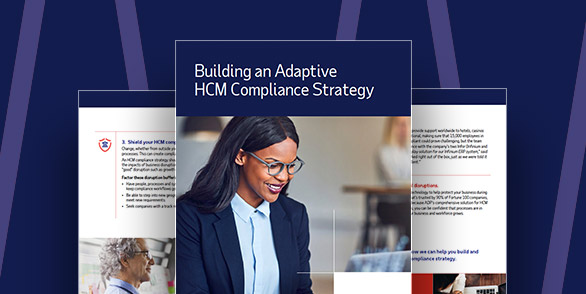
Insight Shield HCM compliance from disruptions
The importance of HR compliance software
As business operations grow in scale and complexity, staying compliant can seem nearly impossible. That’s why many employers swap their manual, labor-intensive processes for an HR compliance-based solution that supports consistent, scalable operations. The benefits of this approach include:
- Improved compliance and mitigated or reduced penalties, fines and interest
- Less burden on internal resources
- Improved efficiency
- Strategic growth
What features should employers look for in labor compliance software?
The critical components of an HR compliance solution include payroll and tax filing, wage garnishment, multi-state operations, employment verification, tax credits, unemployment claims, and Affordable Care Act (ACA) compliance.
Payroll and tax filing
Paying employees in a secure, efficient and timely manner is one of the fundamental roles of an employer. Complying with employment tax payment and reporting rules at the local, state and federal levels is also critical to help avoid stringently enforced penalties.
Wage garnishment
As wage garnishment regulations become more complex, the assumption of risk increases for employers. They can be penalized up to the full amount of an employee’s judgment debt for missed or improper calculations, notifications, payments or other errors in processing or responding to a wage garnishment order.
Multi-state operations
Multi-state employers are subject to various wage and hour laws. An HR compliance provider can help them comply with regulations in the states where they operate now or may operate in the future.
Guidebook Navigating multi-state compliance requirements
Employment verification
From loans to mortgages and credit card applications, employees often need to have their employment status and income verified. HR compliance software can help expedite this process and protect employee privacy.
Tax credits
To participate in tax credit programs, employers often must capture and submit documentation showing that they fulfilled all the tax credit requirements. Incomplete information, missed deadlines or incorrect documentation can result in denied or lost credit opportunities.
Unemployment claims
Unemployment claims are an inevitable part of running an organization, and responding to them can be complicated and time-consuming. HR compliance software can help employers manage unemployment claims by identifying and reducing risks and administrative burdens.
ACA compliance
Efficiently meeting the demands of the ACA’s employer mandate and health coverage reporting requirements can be difficult without an HR compliance solution. Businesses that fail to provide timely, appropriate and affordable access to benefits may be subject to steep penalties.
What to look for in an HR compliance solution provider
Leading HR compliance solutions can help businesses shift from simply meeting compliance obligations to driving opportunities. When evaluating potential providers, employers may want to look for the following:
- Integration with payroll software
- Automated, secure and recurring processes
- Breadth of portfolio
- Government agency relationships – including local, state and federal – where applicable
- Compliance expertise within each functional area
- Business continuity support
Payroll software integrations
Relying on multiple systems from different vendors to manage HCM compliance needs can be inefficient and error prone. The alternative – integrating post-payroll compliance software with payroll – helps eliminate manual workflows and duplicate data entry, improving efficiency and accuracy.
Automated data exchange and analysis
Optimizing compliance efforts through automation can help reduce costs and minimize risk. It also allows employers to redirect resources where they’re needed most. Regulatory requirements may be built directly into the workflows so HR teams can continue their daily tasks with minimal interruption.
Breadth of portfolio
A comprehensive suite of services lends itself to flexibility. When employers rely on a single provider for all their post-payroll HCM compliance functions, their HR teams can shift focus and address more strategic objectives.
Agency relationships
As businesses evolve, they may encounter unanticipated regulations. HCM providers who have automated interfaces with government agencies at the federal, state, and local levels typically can help them accommodate compliance updates easily and quickly due to the availability of data and established communication methods.
Compliance service experts
As part of their service agreement, employers may have access to support specialists with expertise in every area of HR compliance. These experts can answer complicated questions, saving their clients from time spent on research and troubleshooting.
Business continuity support
Whether it's an unforeseen external event, like a natural disaster, or a planned internal event, like a merger, any change can create compliance headaches. A compliance solution provider can help employers continue to meet their compliance needs during disruptions.
HR compliance software challenges and solutions
Modern employers face many HR compliance challenges, including regulatory pressure, workforce expectations and unforeseen disruptions. Responding to them can be an uphill struggle without the right software.
HR compliance challenges
- Regulatory pressure
Regulatory guidelines and legislative changes are increasingly frequent and more complicated. Additionally, organizations have less time to respond to the regulations than previously. - Workforce expectations
Employees today have new expectations for engagement, financial wellness and pay. Meeting these needs can help attract and retain talent, but it also creates new compliance requirements. - Unforeseen disruptions
Unexpected changes – both internal and external – can drastically impact regular compliance processes. Examples of internal disruptions include organizational expansion, hiring surges and business decline. External disruptions include natural disasters, market factors and major legislative changes.
Software solutions to HR compliance challenges
HR compliance software can help turn burdens into opportunities. When employers fully integrate this technology into their HCM systems, they’re often able to:
- Simplify their efforts across multiple HCM compliance processes
- Gain peace of mind that their efforts are in sync with current statutory requirements
- Support their payroll and HR professionals with a directly accessible service team who understands the company and its various HCM compliance needs
What’s more, HR compliance software can often be configured to specific organizational objectives, so employers can quickly scale operations up or down as needed.
Frequently asked questions about HR compliance management software
What is HR compliance software, and why do companies need it?
HR compliance software helps employers manage HR-and workforce-related compliance tasks (e.g., reporting, tracking work authorization and certifying tax credit conditions). Companies use it because there are numerous rules issued by federal, state and local agencies – all on different timelines. These requirements also change frequently and can vary by location, increasing the likelihood of employers overlooking their obligations if they don’t have consistent HR processes.
How does HR compliance software benefit small and medium-sized businesses?
HR compliance software can help small and midsized businesses enter new markets with a better understanding of the employment laws and regulations in the area. Regulatory requirements are built into the workflows, which saves time and allows employers to focus on more strategic, growth-oriented objectives.
How does compliance management software support HR teams in managing compliance risks?
HR teams using compliance software may be able to collect and monitor all the information they need via a single, intuitive dashboard. They can see which tasks are urgent and which can wait, as well as track work being done on the organization’s behalf. With this level of visibility, they can make more informed business decisions in support of compliance.
How can HR compliance software improve HR processes?
Instead of only assigning more people to solve compliance problems, employers can build consistent, scalable processes with the assistance of HR compliance software. This approach may help reduce data integrity issues, automate labor-intensive tasks and gain connectivity and transparency across key compliance functions.
How does ADP compare to other HR compliance software?
ADP offers compliance support across all aspects of the employee life cycle in two key ways. First, employers benefit from the compliance features and security built into our solutions. Second, they’re encouraged to leverage the specialists behind the technology who are focused on staying ahead of the changing regulatory landscape and the potential impact to our solutions. So, whether employers want to extend their existing technology, upgrade from another system or fully outsource the function, we can help.
How do I choose the right workforce compliance software for my business?
Employers can identify the best HR compliance software for them by first evaluating their current state of HR operations. It may help to ask the following questions:
- Is your organization handling HCM-related compliance tasks in-house?
- Are you moving from in-house payroll or HCM to an HCM provider?
- Do you have HR software that isn’t designed to do all the work needed to address regulatory obligations?
- Does your HCM system have an integrated compliance solution built around it?
- Is there an opportunity for more seamless integrations and automation of manual processes?
What problems can HR compliance software solve for employers?
Compliance is a task that’s more challenging for businesses now than ever before. However, software can help them overcome a combination of the following:
- Growing complexity of organizational structures and processes
- Ever-changing legislation and regulations at the local, state, national and global levels
- The struggle to manage all this change with legacy technology and manual methods
How does HR compliance software help with multistate and changing labor laws?
Providers of HR compliance software may have relationships and automated interfaces with government agencies across multiple states. Processes and tools adapt when legislative changes occur, minimizing employers’ compliance burdens and improving their teams’ efficiency and effectiveness.
How is HR compliance software different from manual compliance tracking or spreadsheets?
Using legacy or manual processes to fulfill requirements of regulatory agencies can lead to human error, bottlenecks and delays that ultimately may lead to fines, penalties and even reputational consequences.
HR compliance software, in contrast, delivers the following:
- Integrations with HCM systems to transfer data securely and accurately without the risk of human error.
- Automation that reduces manual intervention, helps flag errors and prioritizes necessary compliance tasks.
- A specific workspace that provides visibility to the entire HCM compliance ecosystem and enables collaboration between internal and external support teams.
This guide is intended to be used as a starting point in analyzing human resources compliance software and is not a comprehensive resource of requirements. It offers practical information concerning the subject matter and is provided with the understanding that ADP is not rendering legal or tax guidance or other professional services. Please consult with your legal counsel.