insight
Choosing the right embedded payroll partner: ADP vs. Gusto Embedded vs. Check
When you bring payroll into your product, you take on work that has real consequences for the businesses you serve. You want something you can trust, something your team can support without extra stress and something your users feel confident about every pay cycle.
ADP Embedded Payroll, Gusto Embedded and Check all offer ways to embed payroll, but they take very different approaches, and each one fits a different type of platform. Here’s what our research shows.
TOP EMBEDDED PAYROLL PROVIDERS
- Best overall embedded payroll solution – ADP Embedded Payroll
- Runners-up – Gusto Embedded, Check
ADP Embedded Payroll: Best for confidence without extra complexity
ADP Embedded Payroll lets platforms offer payroll without becoming payroll processors. ADP’s APIs connect to a system that already handles payroll at scale, supporting millions of employees and over 900,000 small businesses. That level of infrastructure helps reduce the operational risk businesses would otherwise carry.
ADP automates payroll calculations and filings across federal, state and local levels. Few embedded options match this depth, and helping businesses manage payroll tax obligations with greater confidence is one of the clearest benefits. Customers of ADP’s embedded partners get payroll workflows designed to catch common errors.
Onboarding is guided. ADP supports partners through implementation, launch and market entry, which is especially helpful if payroll is a new territory. From a go-to-market perspective, this includes launch guidance and operational readiness support that help platforms introduce payroll confidently as part of a broader product offering.
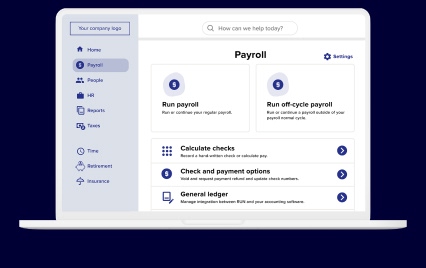
The embedded payroll experience can be supported and launched within partner platforms across desktop, tablet and mobile web environments, without requiring partners to replicate or rely on ADP’s native applications. This approach helps reduce build time without forcing a one-size-fits-all UI.
ADP Embedded Payroll at a glance
Pros
- Reliable payroll engine built for scale
- Strong tax handling and workflows to support compliance
- Robust APIs for onboarding, payroll processing and reporting
- Go-to-market strategy from ADP sales, plus launch support for embedded payroll offerings
- Software Development Kit, including hands-on guidance
- Automated workflows that reduce partner lift
- Structured onboarding, including end-to-end support and developer-focused channels
- UI and admin tools for embedded deployment across web and mobile surfaces
Limits
- Best suited for teams that want a supported solution, not a DIY framework
The main takeaway? ADP Embedded Payroll gives platforms a proven payroll foundation that reduces risk and supports growth without adding complexity. For platforms that want long-term reliability, strong compliance coverage and go-to-market support alongside technical implementation, ADP offers the most balanced embedded payroll solution.
Gusto Embedded: Best for simple, straightforward needs
Gusto Embedded offers payroll APIs, but they follow the workflows of Gusto’s own app for small businesses. This approach keeps things simple, which can be a benefit for teams whose needs align closely with Gusto’s standard flows, but it limits flexibility for platforms that want deeper control or need to support more varied customers. Still, the offering is built for Gusto’s direct customers, not for partners with unique product goals or more varied user bases.
Support and onboarding are smoother for businesses that use Gusto directly. Embedded partners take on more responsibility during implementation, which can create extra effort when building or troubleshooting.
Gusto Embedded at a glance
Pros
- Simple, familiar payroll workflows
- Handles standard payroll and tax cases
- Suited for smaller teams with low-complexity use cases
Limits
- Limited customization for embedded platforms
- Less partner support compared with direct Gusto users
- Less suited for complex or scaled needs
The main takeaway? Gusto Embedded is simple for straightforward use cases, but it offers less flexibility and support than platforms often need as they grow.
Check: Best for teams that want control and can support it
Check is an API-first framework for platforms that want to build a custom payroll experience. You get flexibility, but that flexibility comes with more responsibility.
Instead of a ready-made payroll engine with full workflows, Check provides building blocks. Your team assembles the workflow, UI and operational processes. This approach includes managing more lifecycle logic, exception handling and compliance checkpoints that other providers automate.
Check offers onboarding tools and branded support options, but much of the support model must be built by the partner. This approach can be a challenge for teams that want to move fast or limit long-term maintenance. Teams with strong and ongoing engineering investment may benefit; others may find the operational overhead to be a significant burden.
Check at a glance
Pros
- Flexible API-first structure
- Supports custom workflow design
- Allows deep control for experienced engineering teams
Limits
- Partners carry more compliance and operational responsibility
- Only offers accounting integrations through QuickBooks Online
- Limited partner integrations overall
- Higher build time and maintenance
- Support model must be created by the partner
The main takeaway? Check gives developers control but shifts more work and responsibility to the partner, making it a heavier lift than many teams expect.
| ADP Embedded Payroll | Gusto Embedded1 | Check1 | |
|---|---|---|---|
| Payroll engine | Full payroll engine built on ADP’s proven system | Standard payroll engine | Payroll engine partners assemble into workflows |
| Tax handling | Calculates and files federal, state and local taxes | Handles common tax cases | Provides tax data, but partners manage more of the process |
| Compliance | Strong compliance support with ADP SmartCompliance | Basic small business coverage | Limited compliance support, more partner responsibility |
| APIs | Robust APIs with clear guidance and support | Narrower set of APIs | Flexible APIs that require more engineering work |
| Workflow automation | Automated workflows that reduce lift for partners | Basic workflows | Partners build and maintain workflows |
| Lifecycle controls | Built-in states for running payroll | Not exposed for customized partner workflows | Built-in but requires partner implementation |
| Webhooks | Change-notification webhooks aligned to system of record | Payroll-specific real-time webhooks | Real-time webhooks for state updates |
| Onboarding support | Structured onboarding with guided launch | Partner support via documented channels | Tools provided; onboarding owned by partner |
| UI and admin tools | Mix of APIs, UI options, mobile tools and dashboards | Clean but fixed UI | UI modules that require assembly |
| Go-to-market support | Guided launch and partner enablement for bringing payroll to market | Partner marketing and sales support | Go-to-market owned and executed by the partner |
Final thoughts
Choosing an embedded payroll partner shapes the experience your users have and the workload your team takes on. Gusto works for simple needs and familiar workflows, but its model is less adaptable as platforms grow. Check gives developers extensive control, but with that control comes substantial engineering and compliance responsibility.
ADP Embedded Payroll takes a different approach. It provides a stable payroll engine, strong compliance coverage and guided implementation so teams can offer payroll without becoming payroll processors. For platforms that want long-term reliability with manageable operational lift, ADP delivers the most complete and scalable foundation.
Evaluating embedded payroll for your platform?
See how embedded payroll works, the benefits for SaaS platforms and their customers and the key questions to ask when choosing a partner.
1. As of May 29, 2026 and is subject to change.