
Why Large Enterprises Are Turning to Predictive Analytics and AI for WFM
Part of a series | AI Insights


Predictive analytics, machine learning (ML) and automation can support workforce management (WFM) by helping organizations forecast labor demand, recommend schedules, review time and attendance, manage absences and analyze labor costs. At enterprise scale, these capabilities can help leaders interpret demand across locations, incorporate business and workforce data into staffing forecasts and connect workforce activity with payroll. Managers remain responsible for reviewing recommendations, addressing exceptions and making decisions that affect schedules, pay or access to work.
Key takeaways
Enterprise WFM is difficult because scheduling, time, absence, payroll and compliance must operate across locations, employee groups, business demands and jurisdictions.
Predictive analytics and ML can support demand forecasting, scheduling, workforce analytics and exception detection, but results depend on reliable data, configuration and manager adoption. In practice, reliable data means that employee, job, location, skills, availability, time, absence and payroll records are current, consistently defined and connected across systems. HR Research Institute reports more than one-third of HR professionals report pulling data from four or more systems to create people-analytics reports, illustrating the integration challenge many organizations must address before applying predictive analytics at scale.
The strongest WFM environment connects demand, scheduling, time, absence and payroll data while providing transparency, auditability and appropriate human review.
Business cases should distinguish the value of predictive capabilities from the broader benefits of process redesign, system integration and human capital management (HCM) modernization.
How predictive analytics and ML support WFM
Enterprise forecasting can combine historical workforce activity with relevant business-demand signals, which may include sales, production targets, projected customer traffic, orders, weather and seasonal patterns, depending on the organization’s systems, integrations and configuration. ML can continuously analyze these inputs alongside labor availability, skills and historical demand to help improve staffing forecasts. Predictive scheduling capabilities can then recommend schedules that balance expected demand, employee availability, required qualifications, labor standards and labor-cost targets. Managers review and adjust those recommendations based on current operating conditions and individual circumstances.
For a large enterprise, these capabilities must work across a distributed workforce with different jobs, business units, locations and labor requirements. A useful WFM system does more than produce a forecast, however. It connects recommendations with time and attendance, scheduling, absence management, payroll and workforce analytics so authorized people can act on the information within established processes.
Discover confident decision-making with ADP Lyric HCM
Why large enterprises face unique WFM challenges
Scale multiplies the difficulty of WFM. A small scheduling change can affect coverage, overtime, qualifications, labor cost and employee preferences across many sites. Acquisitions and legacy systems may leave leaders with fragmented data, while different jurisdictions, union agreements and company policies add layers of rules. When systems do not keep pace, managers may rely on spreadsheets, manual reconciliation and repeated corrections.
In ADP’s 2026 global payroll research, based on responses from more than 1,800 senior payroll stakeholders across 20 countries, only about one-quarter to one-third of organizations reported full global integration between payroll and core systems such as HR, time and attendance, accounting and enterprise resource planning (ERP). The research also found that IT teams spend an average of 22 hours per week, per country, managing data flows between payroll and other business systems. Although these findings concern global payroll rather than WFM alone, they illustrate the operational burden that fragmented workforce systems can create at enterprise scale.
Large organizations also need visibility at several levels at once. A site manager needs to fill tomorrow’s shift, finance needs to understand labor-cost trends and enterprise leaders need a consistent view across regions. Employees expect convenient access to schedules, time information and requests. Predictive analytics can help leaders prioritize and analyze this volume, but only when the underlying data and workflows are connected and governed.
How predictive capabilities support enterprise WFM
Demand forecasting: ML can analyze historical workforce activity alongside sales, customer traffic, production, orders, weather, seasonal patterns and other business-demand signals. These forecasts can help leaders estimate staffing, skills, overtime and labor-cost needs, but managers should still account for current operating conditions and local context.
Predictive scheduling and resource allocation: Predictive scheduling software can recommend coverage based on expected demand, employee availability, required skills, labor standards, labor-cost targets and configured rules. Managers can use these recommendations to reduce manual schedule preparation and evaluate potential overstaffing, understaffing or overtime before publishing a schedule.
Time, attendance and payroll review: Analytics and automation can surface unusual entries, missing information or variances for practitioner review before they create downstream work. Connecting timekeeping with payroll can reduce duplicate entry and help teams investigate issues earlier.
Exception and compliance-risk analysis: ML and automation can continuously surface exceptions across locations, identify recurring patterns that may contribute to compliance risk and help prioritize issues that may require managerial review. These capabilities do not guarantee compliance. Organizations remain responsible for maintaining applicable rules, validating system configuration and making employment decisions.
Absence and coverage management: Connected absence, availability and scheduling data can help managers assess coverage, respond to planned or unexpected absences and identify qualified workers who may be available. Managers should address individual situations and applicable leave or scheduling requirements.
Employee schedule access and self-service: Mobile and self-service tools can allow employees to view schedules, submit availability, request time off and complete supported scheduling or time-related actions. These capabilities may reduce manual follow-up and give managers more timely information when planning coverage.
The business impact: Efficiency, cost and ROI
The business case for predictive WFM capabilities should begin with a defined operating problem. For forecasting and scheduling, leaders might measure manager planning time, overtime, open shifts, coverage gaps, schedule changes and manual overrides. For time and payroll, useful measures may include missing time records, corrections, adjustment requests and review time. Software, implementation, integration, training and ongoing governance costs should also be included.
For context, ADP recently commissioned Forrester Consulting to conduct The Total Economic Impact™ of ADP® Lyric HCM. Forrester created a composite 5,000-employee enterprise from four customer interviews and calculated a 259% return on investment (ROI) over three years, $14.1 million in total benefits and payback in less than six months. The study also modeled a 75% to 90% reduction in payroll errors over time. These findings reflect the value of the full Lyric platform, not artificial intelligence (AI) or workforce management alone, and Forrester states that results will vary by organization.
A modern WFM or HCM platform may generate value through several changes at once, including process redesign, data consolidation, workflow automation and predictive capabilities. Enterprise buyers should therefore separate the business case into clearly defined benefit categories rather than attributing every projected gain to AI. For each benefit, document the workflow being changed, the current performance baseline, the technology or process change expected to produce the improvement, the implementation costs and the person responsible for validating the result after launch. This approach helps leaders distinguish value associated with predictive capabilities from the broader value of modernizing the HCM environment.
What to look for in an enterprise WFM platform with predictive capabilities
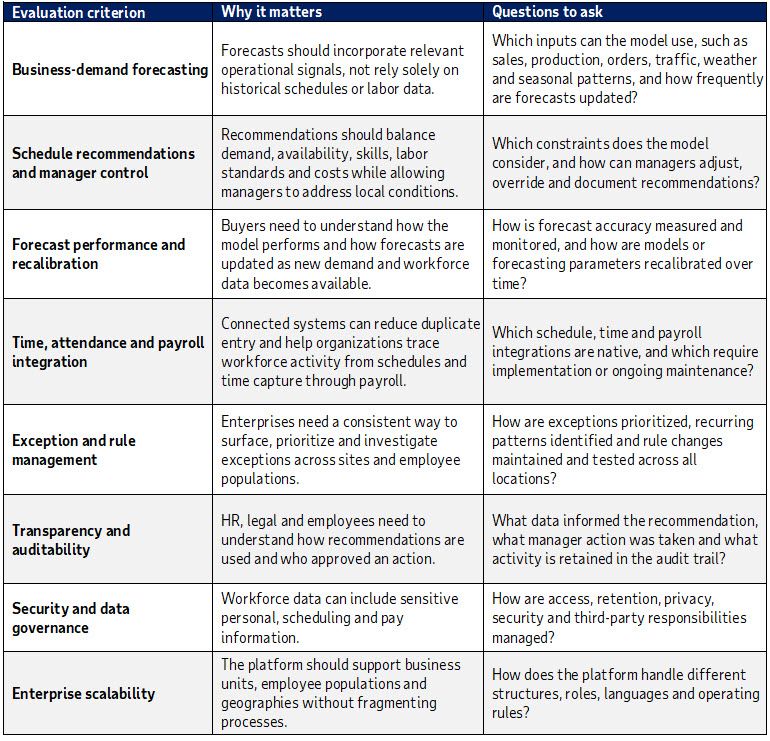
Predictive capabilities are only one part of enterprise WFM. Buyers should evaluate both the quality of the forecasting and scheduling models and the platform foundations required to put their recommendations into practice.
Responsible AI: Managing risk in enterprise WFM
Workforce recommendations can affect hours, pay, opportunity and the employee experience. Organizations should assess potential bias and fairness impacts, limit access to necessary data, test models and configurations, document how outputs are used and establish a process for reporting and correcting problems. Legal and compliance teams should determine which requirements apply in each jurisdiction.
Vendor accountability matters as well. Buyers should ask who is responsible for data quality, model monitoring, security incidents, product changes and explanations of system behavior. Contracts and governance processes should clarify what the provider manages and what remains the employer’s responsibility. Human review should be proportionate to the possible effect on workers.
ADP’s responsible AI principles provide one example of a governance model. They address human oversight, governance, privacy by design, explainability and transparency, data quality, inclusion and training and a culture of responsible AI. ADP also maintains an AI & Data Ethics Committee and describes audits, risk assessments and operational monitoring as elements of its governance approach.
How ADP® Lyric HCM fits into your WFM strategy
ADP Lyric HCM is designed for large, complex enterprises and brings together HR, payroll, workforce management, analytics and other HCM capabilities. Its WFM capabilities include time and attendance, labor management, scheduling and absence management, supported by predictive analytics and connected payroll and HCM data. Product availability, configuration and fit may vary, so prospects should confirm requirements and capabilities with ADP.
A useful evaluation should begin with an enterprise WFM scenario, such as forecasting labor across multiple sites, creating schedule recommendations under different demand and rule conditions or investigating a time-to-pay variance. Ask the provider to show which business and workforce data informs the forecast, how recommendations are generated, how managers can adjust them and how schedule and time activity connects with payroll. This provides a more realistic test of predictive WFM capabilities than a generic AI demonstration.
Discover how predictive, connected WFM can support your enterprise strategy
Explore how ADP Lyric HCM connects workforce management, payroll, HR and analytics in a full-suite platform for large, complex organizations.
FAQs
How long does enterprise WFM implementation take?
There is no universal implementation timeline. Timing depends on workforce size, locations, integrations, data readiness, rule complexity, change management and deployment approach. Buyers should request a phased plan with assumptions, dependencies, testing, training and criteria for moving from pilot to broader rollout rather than relying on a generic estimate.
Does predictive scheduling work for hourly and shift-based teams?
Yes. Shift-based operations are a common use case for predictive scheduling because workforce plans must account for changing demand, employee availability, qualifications, coverage requirements, labor standards and costs. For example, a retailer could use projected customer traffic and historical demand to refresh staffing recommendations across hundreds of locations, helping managers identify potential overstaffing or understaffing and consider coverage in relation to service-level goals. Results depend on the quality of the demand and workforce data, model configuration and manager adoption. Organizations should evaluate recommendations alongside overtime, open shifts, schedule changes, manual overrides and employee experience.
What data should be ready before implementation?
Organizations should identify authoritative sources for employee, job, location, skills, availability, scheduling, time, absence, demand and payroll data. Data should be accurate, current, consistently defined and governed. Leaders should also document access, retention, privacy and security requirements and decide how questionable records or model outputs will be reviewed.