
How HR and IT Can Work Together to Improve Employee Experience in the AI Era


HR and IT can work together to improve employee experience by co-owning the employee journey — from onboarding workflows and AI tool access to data privacy and system rollouts. Research shows that only 55% of HR organizations collaborate effectively with IT, yet those that do are 1.8 times more likely to excel at innovation. In the AI era, closing this collaboration gap requires joint governance, shared KPIs, and a unified view of the employee experience that crosses both domains.
By Steve Goldberg, HCM / HR Technology Influencer, Analyst, Advisor
Key takeaways
Collaboration gap: Only 55% of HR organizations feel they are highly effective at collaborating with IT, largely due to differing priorities and lexicons between the two functions.
Innovation impact: Organizations with strong HR-IT collaboration are 1.8 times more likely to excel in innovation efforts.
IT leader confidence: 93% of IT leaders believe that bringing HR and IT together boosts productivity and employee satisfaction.
AI tool access disparity: While 72% of IT employees feel their AI tool needs are met, only 59% of HR employees feel the same — indicating a gap in access to essential tools.
Onboarding at risk: Negative onboarding experiences — which span both HR and IT workflows — can lead employees to seek new jobs at double the rate of those with positive experiences.
Co-ownership required: HR and IT should share responsibility for the employee experience framework to ensure alignment with organizational culture and employer branding in the AI era.
Current state of HR and IT collaboration
Let's start things off with only 55% of HR organizations reporting to be highly effective at collaborating with their colleagues in IT. Common reasons behind this include these two corporate functions often operating with different priorities at the execution level, and using different lexicons, both of which make bridging this gap challenging. That said, as highlighted in this next stat from that same research from McLean and Company, it's a difference-maker when this higher level of collaboration is achieved:
Organizations where these teams work well together are 1.8x more likely to be high performing when it comes to innovation efforts.
Perceptions from IT leaders
Another, largely corroborating study, found 93% of IT leaders surveyed believing that bringing HR and IT together usually resulted in increasing productivity and boosting employee satisfaction. But despite this and the compelling findings above, my personal interactions with scores of HR and IT leaders over my four-decade career (across senior practitioner, vendor and analyst/advisor roles) consistently suggested that when HR and IT teams co-sponsored strategic initiatives like an HR Technology rollout, it more often than not happens with unequal degrees of enthusiasm and commitment.
Disparities in AI tool access
A possible clue as to what is feeding this organizational dynamic comes from the Microsoft research finding that 72% of surveyed IT employees stating their organization provided all or most of the AI tools they needed; but in contrast, only 59% of surveyed HR employees felt their company met their AI tool requirements. Interestingly, while HR / HCM software vendors have flooded the market with a range of AI-powered tools and capabilities that are both broad and deep, another study by General Assembly revealed that only 30% (a staggeringly small number) of HR professionals were receiving comprehensive, job-specific AI training. And ADP's 2026 HR Trends Study reported that 65% of companies face obstacles and challenges in providing skills development opportunities for employees.
The need for HR-IT convergence
Organizations are clearly facing the reality that HR and IT can no longer operate in silos. The rise of hybrid and remote work has stretched IT oversight over tech initiatives fairly thin, while HR is increasingly pulled into technology decisions like device provisioning at the tactical/administrative level ... to AI-related access management, governance, and compliance. We're talking about an HR-IT convergence, extending from the operation and execution level within organizations to the HR and Payroll Technology solution landscape, related go-to-market positioning and the prevalent functionality being sought by customers.
Unified employee experience
Indeed, the 'people experience' can no longer be separated from an employee's technology experience. Today's employee journey is a continuous flow of moments that cross both functions. Employees experience those moments as one unified process, not as separate department responsibilities. This also demands closer collaboration between HR and IT because the moments that shape an employee's early confidence in their role and team depend on workflows that cross both domains. In that context, I'll also cite the thought-provoking research findings from ADP Research that "AI adoption involves and changes how work feels --- before it results in how work gets performed."
Aligning workforce systems rollouts
HR and IT must also collaborate well to ensure all workforce related systems rollouts should be very aligned with and supportive of the target organizational culture and employer brand -- rather than just elevating system capabilities via the presence of AI. Finally, with respect to the onboarding experience being a time when so many employees are thinking about whether they made the right decision to join, findings from research and analysis firm HR Dive underscores the fact that employees having negative onboarding experiences will seek new employment at double the rate of other employees.
Ready to turn today's HR-IT pressures into tomorrow's productivity gains? Learn more
Co-ownership of the employee experience (EX)
The EX framework
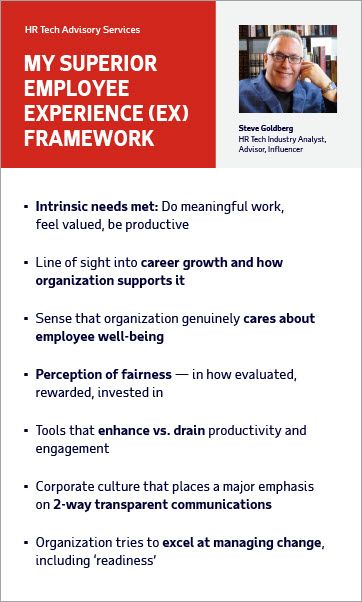
Roughly seven years back I developed what I referred to as an Employee Experience or 'EX' Framework (see pic), with the word 'superior' implicit in the title. Since the collaboration or teaming opportunities and related best practices between HR and IT colleagues is not always evident across the framework, I'll provide perhaps a few less obvious examples in a bit –- ones that relate to the 'AI era' in particular.
High sensitivity in changing times
But I will preface that with these two comments: (1) I believe this type of (Superior) EX Framework or perspective should be prominent in the thinking of HR leaders given the sensitivity that needs to be shown to the human segment of the workforce during these fast-changing, somewhat uncertain times or unpredictable times; and (2) Given everything the AI era represents ... from opportunities for significant efficiency gains and operational improvements to easier strategic shifts if not transformations (requiring HR-led readiness assessments and change management); and given the primary role IT plays in the 'how' part of the "what's next for our organization"? discussion, I'd assert that the following EX depiction and related execution should be co-owned between HR and IT.
5 best practices for successful HR–IT collaborations (in the AI era)
Form a cross-functional task force: Establish joint steering committees to align mutual goals before making major technology purchases.
Define joint KPIs: Measure the success of tech rollouts by both system performance (IT) and user adoption rates (HR); establish joint acceptance criteria for determining when systems are ready to go live.
Collaborate on retention of key tech talent: HR should have major visibility and know best mitigating actions to be taken when key IT / Tech employees who are well versed in the latest AI advances are deemed retention risks, including the leveraging of AI to detect associated or predictive signals and cues.
Ensure seamless system integration: Ensure all HR systems communicate seamlessly with the company's broader digital ecosystem to eliminate information silos or confusion stemming from partly duplicative data or systems.
Embrace ownership flexibility: Given the extent and frequency to which organizations and roles are being redesigned these days to take advantage of AI and other tech advances, organizational cultures should account for this, perhaps in the form of de-emphasizing 'what used to be' in relation to who owns what -- and being open about discussing ownership tradeoffs.
How the HR-IT collaboration has changed over the years
The HR-IT relationship during the time I occupied the role of VP, HRIS at four investment banks, always reporting to a CHRO (the first 15 years of my career) was largely about HR needing specialized (i.e., best of breed) software for an HR process area or payroll, or a complete suite (aka HR tech platform) and IT acting as the gatekeeper, plus managing security, installations, data maintenance, perhaps integrations with other corporate systems, etc. HR would also be involved in testing, possibly coming up with use cases for the vendor selection process, and in many instances, funding the total cost of deploying a new app or total system.
The dynamics above were common to my HR Tech jobs through the early-to-mid 90's, and then things changed. The collaboration between these two areas definitely started evolving into a more strategic partnership, one where the boundaries of authority and involvement over HR-IT matters and initiatives became more blurred. A major reason for this is that both parties sought to become much more knowledgeable about the other's domain.
One of the catalysts for this: The increased reliance on data-driven decisions and "people analytics" that offer both parties an opportunity to partner in creatively investigating and solving workforce issues. Then, since I transitioned to my vendor executive position at Peoplesoft in 2000 -- leaving behind my bird's eye view of this evolving collaboration, I'll fast forward to the current AI era and make this observation: With distributed, global workforces and use cases for AI Agents alone proliferating faster than most would have predicted, HR and IT are now jointly responsible for data privacy, protecting employee data from cyber threats, ensuring sources of commonly used, critical content are certified, and most anything else that can be considered an area of AI-related operating risk.
Are you ready to turn today's HR-IT pressures into tomorrow's productivity gains? Learn more
About the author:
Steve Goldberg has operated in senior roles on all sides of HR, Payroll, Talent Management and HR Tech for over three decades and on three continents. After 15 years as a practitioner exec in Fortune 500's, Steve led HCM product strategy at PeopleSoft, co-founded Recruiting Tech, and Change Management firms, and directed HCM research practices at Bersin and Ventana Research. Currently serving as an independent industry analyst and advisor, Steve has been recognized as a Top 100 HR Tech Influencer multiple years. He holds an MBA in HR.
FAQs
Why do HR professionals have less access to AI tools than IT employees?
Microsoft research found that 72% of IT employees feel their AI tool needs are met, compared to only 59% of HR employees. This disparity may stem from IT teams controlling tool provisioning and prioritizing their own workflows. Closing this gap requires joint governance over AI tool selection and deployment so that HR's needs are weighted equally in purchasing decisions.
How does HR-IT collaboration affect employee onboarding?
Onboarding spans both HR and IT domains — from benefits enrollment and culture orientation to device provisioning and system access. Research from HR Dive shows employees with negative onboarding experiences seek new employment at double the rate of those with positive ones. Coordinating HR and IT workflows during this critical window helps instill early confidence and reduces the risk of early attrition.
What is the first step to improving HR-IT collaboration?
Establish a cross-functional task force or joint steering committee to align mutual goals before making major technology purchases. Define joint KPIs that measure both system performance (IT's domain) and user adoption rates (HR's domain) to ensure shared accountability for outcomes from day one.