
Tax Treatment of Tips and Overtime: Answers to Your Employees' FAQs
Part of a series | The One Big Beautiful Bill Act Series


This article provides answers to four common employee questions: Why are my tips and overtime still being taxed? What are qualified overtime and qualified tips? Can I adjust my federal withholding? And, how can I adjust my withholding?
Benjamin Poor, senior counsel in human capital management at ADP, contributed to this article.
Share this infographic with employees and consider using the linked sample employee communication to help them better understand the answers to these questions. 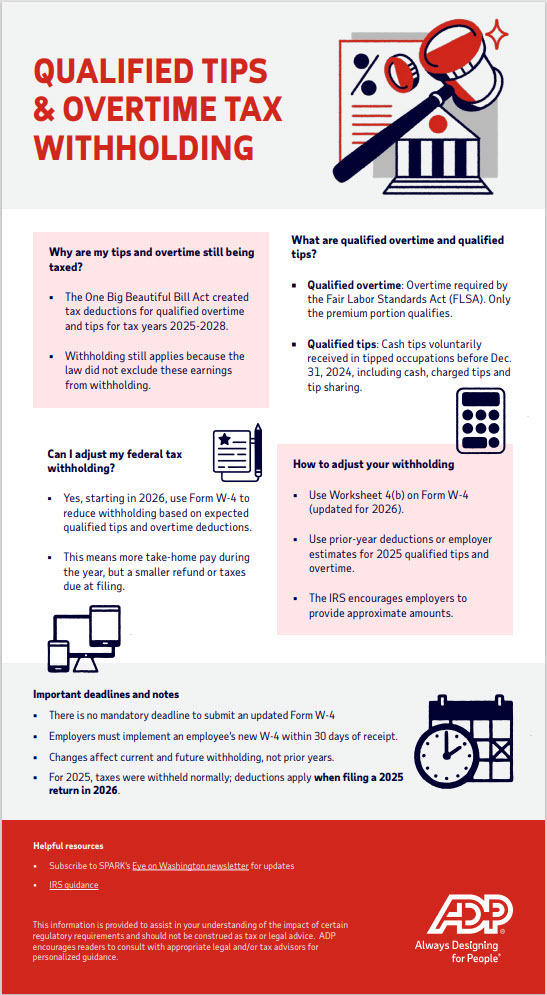
Why do my employees continue to be taxed on tips and overtime?
The One Big Beautiful Bill Act (the Act) created tax deductions for qualified overtime and qualified tip amounts for tax years 2025-2028.
The legislation did not specifically state that qualified overtime and qualified tip amounts would be excluded from withholding, which is why earnings related to both of these categories are still subject to withholding today.
"Qualified overtime" compensation means overtime required to be paid under Section 7 of the Fair Labor Standards Act (FLSA). Overtime not required by the FLSA (such as potentially more generous overtime required under state laws, a collective bargaining agreement or paid voluntarily by employers) is therefore not eligible for the deduction. In addition, only the premium portion of overtime may be eligible for the deduction. For example, if an individual is paid $10 per hour for non-overtime earnings, and $15 per hour for overtime, only the $5 per hour premium pay for overtime is eligible for the new tax deduction.
"Qualified tips" means cash tips voluntarily provided to an individual in an occupation that customarily and regularly receives tips on or before Dec. 31, 2024. "Cash tips" for purposes of the Act include tips received from customers that are paid in cash or charged and, in the case of an employee, tips received under any tip-sharing arrangement.
Note: The IRS previously announced that there would be no changes to reporting and withholding for tax year 2025. This means that employees' wages related to qualified tips and qualified overtime had taxes withheld from them in tax year 2025.
However, for tax year 2025, employees who have eligible cash tips or qualified overtime will be able to seek a tax deduction on their 2025 tax return when filing in 2026.
How do I help my employees understand how to adjust their federal income tax withholding to account for their expected qualified tip and qualified overtime deductions?
Beginning in 2026, employees can now use their Form W-4 to reduce their withholding based on expected qualified overtime and qualified tip deductions. Forms W-4 are prepared by employees only. To assist employees in determining how to prepare their Form W-4, employers can direct employees to the IRS Form W-4 instructions.
Employees seeking to reduce their withholding to account for expected qualified overtime and qualified tip deductions will need to use the Deductions Worksheet for Line 4(b) of the form to calculate their reduced withholding amount. Worksheet 4(b) is not a new worksheet; however, the inclusion of qualified tips and qualified overtime amounts on the worksheet is a new update for 2026.
Employees who submit a new Form W-4 to reduce withholding to account for deductions will be able to effectively receive the benefit of the deductions during the tax year. Employees would receive larger amounts of after-tax dollars each pay period due to the decrease in federal income tax withheld. However, because less income tax is withheld during the course of the year, the employee's potential income tax refund would also decrease, or they may owe some additional amounts at the time of filing their taxes.
What information may be helpful for employees to review as they prepare their Form W-4?
Generally, employees use prior-year deduction totals and information related to expected deduction amounts in the current year to fill out Worksheet 4(b). Employees who want to decrease their withholdings would likely do so based on earnings and taxation in the prior tax year. In the case of deductions for qualified overtime and qualified tip amounts, it may be slightly more difficult as the deductions were introduced retroactively in 2025, and employees may not have their full deduction amount calculated yet for tax year 2025. If an employee wants to submit an updated Form W-4 to account for the deductions prior to filing their 2025 tax return, employees may want to consider information provided to them by employers showing 2025 amounts for qualified overtime and qualified tips.
The IRS recently provided guidance (IRS Notice 2025-62) granting penalty relief to employers and further affirming that they are not obligated to provide employees with specific accounting of qualified overtime and qualified tip amounts; however, the IRS strongly encouraged employers to provide employees with an approximate accounting of these amounts to help employees claim deductions in 2025. The IRS also recently issued guidance (IRS Notice 2025-69) related to how employees can use the information provided by employers to claim the deduction for qualified overtime and qualified tips on their 2025 tax return. This information can also likely be used to assist employees in preparing Worksheet 4(b).
In all cases, employees may want to consult a tax advisor for further guidance on the tax implications of accounting for potential deductions related to qualified overtime and qualified tips on their Form W-4.
When do employees need to submit their updated Form W-4?
There is no requirement for employees to submit an updated Form W-4 at any point. Employees are only required to submit the form once, when they are initially hired. Should an employee wish to submit an updated Form W-4 to adjust their withholding, they may do so at any time. Additionally, employers are required to accept and implement newly submitted Forms W-4 no later than the start of the first payroll period ending on or after the 30th day from the date they received the revised Form W-4. Once implemented, the employees updated Form W-4 will impact their current year/future tax withholding. It will have no impact on the prior tax year's withholding.
For further guidance related to employer requirements involving Form W-4, consult IRS Tax Topic 753.