
The Seasonal Side of Workers' Compensation: What Employers Need to Know


Understanding how seasonality affects workers' compensation could help your organization stay compliant, control costs, and protect your workforce during peak-demand months.
From summer construction surges to winter retail rushes, every industry has a "busy season." Often, these times coincide with spikes in workplace injuries. While plaintiff-oriented explainers dominate online search results, few resources help employers anticipate when claims may rise, why they do, and how best to prepare for the nuances of seasonal, part-time, and agricultural workforces.
"Workers' compensation doesn't take a vacation," says Mila Cortazzo of Automatic Data Processing Insurance Agency, Inc. (ADPIA®). "The key is recognizing your organization's exposure cycle and planning ahead for the payroll, classification, and coverage implications that come with seasonal work."
In this article, we'll explore the seasonality of workers' compensation – from injury patterns and eligibility myths to compliance checklists and strategies for variable payrolls.
Understanding workers' compensation seasonality
Seasonal work is essential to the U.S. economy. Recent data suggest that roughly 17 percent of the U.S. workforce consists of part-time or temporary workers (those working fewer than 35 hours per week). Whether it's summer construction, harvest crews, or holiday retail staffing, these temporary surges create unique risk profiles.
A careful study of workers' comp claims data reveals clear seasonal trends across industries:
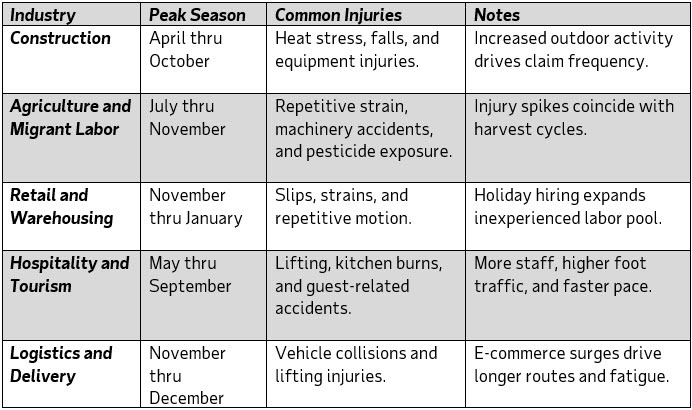
"These trends aren't just data points," explains Cortazzo. "They directly inform how you manage premiums, claims, and compliance throughout the year."
Seasonal workers and workers' compensation eligibility
One of the most common misconceptions among employers is that seasonal or part-time workers are not eligible for this coverage.
In reality, eligibility is determined by state law, not employment duration. Most states, under most circumstances, require coverage for any employee – full-time, part-time, or seasonal – performing work in the course of business.
Likewise, a seasonal worker can generally collect workers' compensation benefits as long as the injury prevents them from working, within the limits of state-specific duration rules and medical recovery timelines.
For businesses with agricultural or migrant workers, coverage rules vary. For instance, some states exempt small farms or certain labor arrangements. However, larger operations or those employing migrant labor under federal programs are required to provide workers' compensation coverage.
For more information and context, please visit our Workers' Compensation 101 FAQ page.
State-specific workers' compensation deadline considerations
State rules can vary significantly in terms of filing deadlines, eligibility waiting periods, and classification requirements. Here are a few examples:
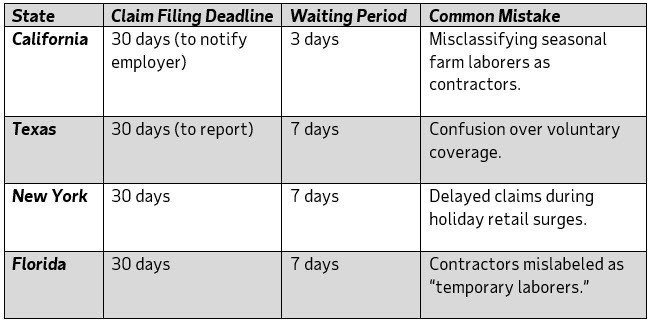
"Misclassification is the most expensive mistake employers make," warns Cortazzo. "If someone is performing work under your direction, they're usually counted as your employee – and you're responsible for coverage."
How workers' compensation claims are calculated for seasonal employees
Workers' compensation benefits are traditionally based on the employee's average weekly wage prior to their injury. For seasonal workers, this is often prorated based on their total earnings during the employment period.
"Sometimes, employers assume that a short-term worker means a short-term claim," explains Cortazzo. "But once a claim is open, benefit duration depends on recovery, not the calendar."
For a deeper dive, see how workers' comp is calculated for seasonal employees.
Compliance checklist
Before peak season hits, employers should review the following:
- Verify workers' compensation coverage for all worker classifications, including seasonal and part-time roles.
- Audit contractor relationships for potential misclassification.
- Review state-specific filing deadlines and waiting periods.
- Implement pay-as-you-go payroll integration for dynamic headcounts.
- Communicate claim-reporting procedures to all managers and supervisors.
Managing payroll fluctuations
Traditional workers' compensation policies base premiums on estimated annual payroll, which can lead to overpayments or surprise bills after year-end audits.
For employers whose headcount changes with the seasons, options like ADP's Pay-by-Pay® Premium Payment Program could be a viable option to help manage your seasonal workers' compensation needs. It integrates your workers' compensation payments directly with your payroll provider, adjusting premiums in real-time as your workforce expands or contracts throughout the year to aid both cash flow and audit readiness.
To learn more, please visit the workers' compensation insurance page of ADP's licensed affiliate, Automatic Data Processing Insurance Agency, Inc. (ADPIA®)
The key takeaway
Workers' comp seasonality isn't just about timing – it's about preparation. By anticipating seasonal injury patterns, clarifying eligibility, and implementing flexible coverage needs, employers can protect both their employees and their bottom line.
"When employers prepare for risk cycles," says Cortazzo. "They gain not just coverage, but confidence."
Remember, you're not in this alone. There are licensed professionals or insurance agencies like ADPIA, that can help discuss your individual business insurance needs. They can help you to stay compliant with laws and regulations, as well as get the most out of your workers' comp plan.
"At the end of the day, seasonal readiness is risk management," concludes Cortazzo. "Aligning your policy structure, payroll process, and compliance plan before your busy season makes all the difference."
To learn more about protecting your employees, check out ADPIA for the latest in workers' compensation insurance.
Automatic Data Processing Insurance Agency, Inc. (ADPIA) is an affiliate of ADP, Inc. All insurance products will be offered and sold only through ADPIA, its licensed agents or its licensed insurance partners; One ADP Blvd. Roseland, NJ 07068. CA license #0D04044. Licensed in 50 states. Certain services may not be available in all states with all carriers. Some carriers may charge an additional fee for services. This information is not intended as tax or legal advice. If you have any questions, contact a tax or legal professional. ADP, the ADP logo and ADPIA are registered trademarks of ADP, Inc. Copyright © 2025 ADP, Inc. All rights reserved.