
Maximizing Benefits: Understanding the Tax Advantages to Premium Only Plans (POPs) and Health Reimbursement Arrangements (HRAs)


Balancing cost with compliance, employers should consider new, tax-incentivized employee health benefits coverage options.
A new year means fresh opportunities, especially in business. As we approach 2026, many companies are looking for ways to optimize their tax savings, particularly when it comes to their employees accessing quality health benefits. Deciding which benefits route to take is a critical business decision that requires careful deliberation on factors like cost, eligibility requirements, coverage options, and individual needs.
Two exciting tools that could be beneficial are Premium Only Plans (POPs) and Health Reimbursement Arrangements (HRAs). These plans offer tax-advantaged strategies that can help businesses of all sizes reduce their budgetary costs, while providing valuable employee benefits at significant savings.
In this article, we'll guide you through the most important aspects of both POPs and HRAs – showcasing some advantages for each, in terms of administration, cost, and plan availability/flexibility.
What is a premium only plan (POP)?
A Premium Only Plan (POP) is a type of cafeteria plan under Internal Revenue Service (IRS) Code Section 125 that allows employees to pay a portion of their health insurance premiums on a pre-tax basis – creating savings for both themselves and their employer.
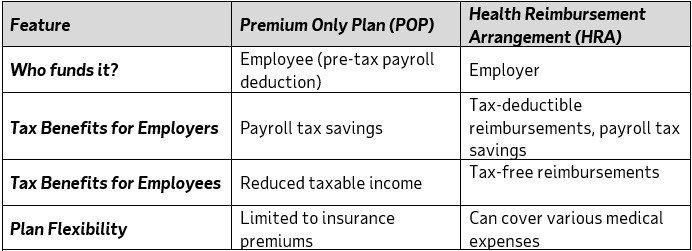
For instance, employers do not pay payroll taxes (i.e., Social Security and Medicare) on the portion of employee salaries used for pre-tax health insurance premiums. Likewise, employee contributions help them reduce their taxable income – resulting in lower federal and state income taxes, and increased take-home pay.
When it comes to compliance, POPs are simple to implement and maintain. For example, you can integrate a POP into normal payroll processing programs – delivering summaries of benefits and ongoing documentation.
"POPs are a cost-effective option for small and medium-sized businesses who worry about high administrative burdens," says LaTasha Ahl, licensed agent at Automatic Data Processing Insurance Agency, Inc. (ADPIA®) and vice president of ADP®. "Plus, employees will love that they have options to fit their personal circumstances and financial goals."
What are health reimbursement arrangements (HRAs)?
Another possible benefits option is a Health Reimbursement Arrangement (HRA). These are employer-funded accounts that reimburse employees for qualified medical expenses, like health premiums and prescriptions.
For employers of all sizes, an Individual Coverage HRA (ICHRA) will reimburse employees for individual health plans or medical expenses based on company-defined eligibility criteria. This option does not have participation requirements that you often see with traditional group health plans.
Unlike a POP, HRAs are funded exclusively by employers and do not require employee contributions. HRA contributions are 100 percent tax-deductible as a business expense and employers yield additional tax savings by not paying taxes on HRA reimbursements.
"Employees also benefit from HRAs," adds Ahl. "After all, they receive funds for their health benefits, without having to include them as taxable income. A true win-win!"
Comparing POPs and HRAs
Why consider a POP or an HRA plan and why now?
As healthcare costs continue to rise, businesses and employees alike must find innovative ways to manage expenses effectively. Implementing a POP or an HRA allows a company to maximize savings throughout the year, while also providing essential health benefits to their workforce.
Moreover, if you want to work with a licensed insurance agent, call on ADP® affiliate, Automatic Data Processing Insurance Agency, Inc. (ADPIA®). Sharing your individual business needs with an insurance agent or broker, and other professionals, will help you to stay compliant with laws and regulations, as well as get the most out of your health benefits plans.
"Business is about growth and investment," concludes Ahl. "By leveraging either a POP or an HRA into your plans, you're showing your employees that you're committed to their health and well-being – while still achieving substantial savings and controlling costs."
To learn more about protecting your employees and your business with insurance, check out ADP® affiliate, Automatic Data Processing Insurance Agency, Inc. (ADPIA®), for the latest in health benefits insurance.
Automatic Data Processing Insurance Agency, Inc. (ADPIA) is an affiliate of ADP, Inc. All insurance products will be offered and sold only through ADPIA, its licensed agents or its licensed insurance partners; One ADP Blvd. Roseland, NJ 07068. CA license #0D04044. Licensed in 50 states. Certain services may not be available in all states with all carriers. Some carriers may charge an additional fee for services. This information is not intended as tax or legal advice. If you have any questions, contact a tax or legal professional. ADP, the ADP logo and ADPIA are registered trademarks of ADP, Inc. Copyright © 2025 ADP, Inc. All rights reserved.